Why an AI That Truly Knows You Changes Everything
The machine got faster. The business has to change.
THE THREE WAVES
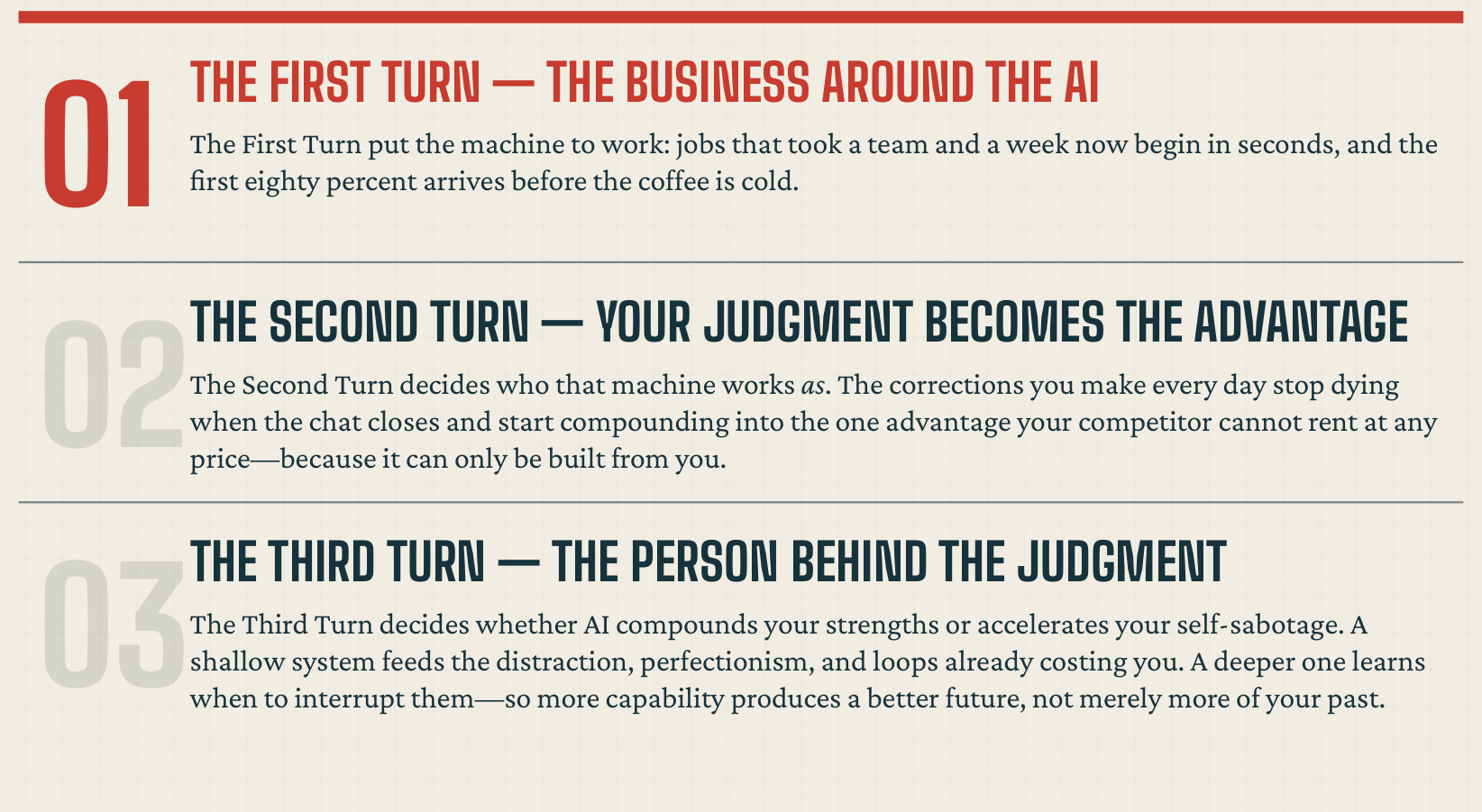
First, make the machine useful. Then make its capability yours. Then make sure all that leverage is carrying you toward the future you chose.
The money is already moving toward people no more talented than you.
Whether you want AI to make more money in the business you already have, help you launch an AI-native business, or simply bring more of what you are capable of into the world—or, like me, you want all three—the path begins in the same place.
Because there are three specific reasons AI has not gotten you there.
All three have fixes. I know because I watch entrepreneurs apply them inside our AI programs and begin turning AI into revenue while the program is still underway.
In the pages ahead, I’ll walk you through each fix, step by step. You’ll see what is blocking the money, how to remove it, and what your business must become to compete in the age of AI.
READ THIS BEFORE YOU OPEN YOUR AI AGAIN
You’re about to uncover what most entrepreneurs will never know about AI.
Because you’re about to see:
- How a bootstrapped founder built and sold his company for $80 million in one year with less than 10 employees (and most entrepreneurs are NOT doing this)
- The 80% Trap: the dangerous false sense of productivity AI gives you BEFORE you’ve shipped your product, launched your business or generated more revenue
- Why the advice that built hundreds of 8, 9, and even 10-figure online companies is now outdated. I know because I wrote the blueprint for their growth - and 5 million people downloaded it.
- The ONLY multi-million or billion-dollar business asset you have now, which no competitor can buy, no model can generate, and no vendor can own (unless you hand it over.)
And by the end of this report, you’ll have everything you need to plug the exact same tools into YOUR business… So you too can experience exponential growth with AI.
There is no buy link at the end of this report and I am not asking you to buy anything here. This report is about moving YOU toward your highest potential in business and life.
If I succeed in doing that, my hope is you share this report with others who are ready to experience their infinite potential with this technology.
By sharing I mean post, gift, text, email, print - anything and everything as long as you don’t change it and don’t claim you wrote it - and give away the secrets your friends might not find on their own.
Sound fair? Let’s dive in.
THE MOST DANGEROUS HAND IN POKER APPLIED TO AI
In poker, the worst hand rarely breaks you. You look down, see garbage, fold, and lose almost nothing.
The most dangerous hand in poker is the second best one at the table. It’s strong enough to trust. Strong enough to go all in and bet everything. But there’s one hand that beats it. And that one hand is the one you never see coming.
Right now, you may be holding the second-best hand with AI in your business.
“The most dangerous hand isn’t the worst one. It’s the second-best.”
A full house, aces over kings. Strong enough to bet everything on — and beaten by the one hand you never saw coming.
Meaning, you use AI. You make things faster. You keep up with every new release.
And that feels like winning.
But second best never feels like losing. In fact, it feels like winning right up until the cards turn over.
That’s why it’s time to ask yourself the question most entrepreneurs aren’t asking:
How would you even know if the way you use AI is setting you up to win—or lose?
You wouldn’t know from the speed of the output your AI gives you. You wouldn’t know from the number of AI platforms you use.
And you definitely wouldn’t know from the amount of time you’re spending with AI.
So let me ask you this…
Has AI changed your business?
Has AI made you more money?
Has AI given you more time to do what you do best?
If you answer honestly, the answer is probably NO.
Because winning with AI isn’t just about having AI… or using AI…
It’s about fundamentally transforming the way you build, operate and produce value AS A RESULT of AI.
So realize…
THIS IS NOT A WARNING ABOUT SOMETHING COMING
The shift in who wins and loses with AI has already begun. Just look around. Maor Shlomo started Base44 alone and bootstrapped it. Within months, Wix acquired Base 44 for $80 million. And Base44 had fewer than ten employees.
And Maor’s not a fluke. Pieter Levels — one man, no staff, no funding, a dozen profitable products — took a brand-new product from zero to a million a year in seventeen days with AI writing nearly all the code. And Pieter posts his numbers live on X. Go look up @levelsio.
AI success stories are everywhere once you start looking. In high school, Zach Yadegari started Cal AI — point your camera at your plate, the AI counts the calories. It made thirty million dollars in revenue last year and sold to MyFitnessPal the day he turned eighteen.
Danny Postma runs HeadshotPro alone from Bali — AI headshots, three hundred thousand dollars a month, zero employees.
And it isn’t just solo operators. Small teams are growing big businesses fast. Vulcan builds software for state governments — from a founding team that can’t write code. They described what they wanted, the AI built it, and within months Virginia’s governor signed an executive order requiring every state agency to buy it and run it. Built by non-coders. Mandated by law.
And Cursor: at the end of 2023 they had 20 employees and did a million a year. Today, 2026, in under 3 years… Cursor has three hundred employees doing $4 billion in revenue. Which means their headcount grew 15x while their revenue grew 4,000x. That’s the fastest growing software company in history. And all this happened before being acquired by SpaceX for $60 billion.
THAT’S winning with AI.
Now, know this:
THEY DIDN’T BEAT YOU WITH BETTER AI. THEY BUILT FORTUNES WITH WEAKER, OLDER MODELS
That’s right - every success story you just read was built on models weaker than the ones on your screen right now.
So answer the only question that matters:
Why isn’t their story yours?
You know the answer isn’t the tools. You have the tools. You have probably bought too many of them.
So you have to move beyond all the hype, buzz, and FOMO and check in with yourself:
Is AI increasing your bottom line profits?
Is it growing your net worth?
Is it actually making your life better?
It’s one thing to do all the prompts, or upload voice samples, or give AI your biggest context files. Or even follow experts on social media and implement their advice.
But at the end of the day... ask yourself:
Is AI fundamentally changing your business?
And no, I’m not talking about throwing together a draft or presentation now in minutes instead of days or hours. That’s great. I’m talking about your entire business.
EVERYTHING.
The thinking, the planning, the operations, the creativity, the execution, the follow up, and the machine that runs your business BEFORE and AFTER your customer ever sees that presentation you built in minutes with AI. Because truth is, if AI hasn’t enhanced each and every piece of any workflow inside your business that drives results today... then...
AI just creates FALSE EFFICIENCY that does NOT drive real results...
And that’s why it’s not growing your current revenue, or adding new sources of income, or even allowing you to work less to earn the same money.
You, and 99% of AI users, are on the hamster wheel. Meaning, your accelerating the work. But you’re not growing your income.
And after enough rounds of that, a nagging suspicion begins to form in your head.
You would never post it. You would never say it at a mastermind table at two in the morning.
“Maybe it is me. Maybe *I’m* the problem. Maybe I’m just missing something.”
WHAT ENTREPRENEURS TELL ME IN PRIVATE WHEN AI ISN’T MAKING THEM MORE MONEY
No matter what doubts you have right now, I’m here to say:
IT’S NOT YOU.
And by the end of this letter, I’ll prove it to you.
Because I see patterns very few people ever get to see. I coach business owners. Dozens of business owners in dozens of different business.
And coaching only works when someone tells me what is actually happening—not the polished version they want everyone to know about, the real truth.
The shit they hate to admit. You know what I’m talking about. The stalled launches. The abandoned systems. The places where the business keeps falling back on them. The doubts, fears and uncertainties they cannot share with anyone else.
And if my clients opening up to me isn’t enough, before a client enters one of my higher-level programs, my AI intelligence system interviews them.
Meaning, with their approval, it gathers the documents, offers, numbers, and decisions that explain their business. Then it builds a forensics-level dossier detailed enough for my team and our AI to build their architecture, agents and skills.
I’m not telling you this to impress you. I’m telling you this so you understand the depth and visibility I have into businesses and entrepreneurs just like you.
Hundreds of those dossiers sit in the system I use every day.
Different markets. Different personalities. Different stories. And each business owner believes their challenge in making AI work for them is unique. So after reviewing hundreds of dossiers myself, I’d have to be blind not to see the patterns.
Because what they think makes them different, actually makes them the same.
What I mean is...
The root cause of all their “unique” challenges can ALL be traced back to just three problems.
And yes, there are only THREE.
Three problems we will solve together in just a moment. But before I show these problems and how to fix them, you should know why I am the person telling you to take this road—and why I know these fixes work.
I’M THE MOST FLAWED PERSON I KNOW - AND THAT EXCITES ME
I’m going to get pretty vulnerable here in this report. That means I’m going to share things I would normally rather keep private: my personal shortcomings, the challenges and setbacks underneath everything I’ve learned, the limits I’ve battled with.
I’m also going to share my triumphs and the track record of success that gives me the right to ask you to act on what I’m about to teach you. Because you deserve the whole picture, unfiltered.
So here’s where I am today. When I step in front of the five screens on my desk, it feels like I am putting on an Iron Man suit.
The real Rich Schefren can’t even send an email through Keap or GoHighLevel. I cannot design a webpage, hook up a funnel, or do half the technical things required to carry an idea into the world.
But now, in front of my machine (my complete computer setup - mobile, cloud, desktop), I feel like I can do anything.
At fifty-five, I am more excited to work than I was at twenty-five. I come to my desk asking a question I never used to ask: What awesome thing can I create today that will move my business or life forward?
I feel like a kid again.
For most of the past twenty-five years, saying I was excited about working would have been a strong overstatement.
I dragged myself to my desk thinking about everything I was behind on, everything waiting for me, and everything that required me to struggle up against something. I could do well, but only with intense effort paired with a lot of caffeine, stimulants and beating myself up along the way
Why?
Because despite having vast marketing and business knowledge - so much so that a single day of consulting from me could produce millions or even billions in value for others - I could never personally execute even HALF of what I knew was possible.
I could see the right move for someone else with painful clarity. I could hand it to them, watch them build an empire, then return to my own desk and stall.
Nearly three decades of journals. Volume after volume of things I knew I should do and did not.
That gap between knowing and doing has been the central fight of my life. It is also why I spent twenty years studying the person underneath the business: how you see, decide, avoid, commit, change, and get in your own way.
I did not know that work would become the foundation of everything AI needs next.
HOW A CLIENT TURNED MY ADVICE INTO A $1.25 BILLION COMPANY
More than twenty years ago, I built the first online business coaching program. The video lessons, live calls, and structured coaching model you now see everywhere had no established model I could copy. Many of the people who later led this industry were my students, or students of my students.
I helped Bill Bonner’s Agora grow from $250 million to $1.25 billion in a year. I coached Ryan Deiss before DigitalMarketer became a multi 8-figure juggernaut. Russell Brunson before ClickFunnels hit $100M ARR and a $800 million peak valuation.
Most of the early “who’s who” of internet entrepreneurs could tie some meaningful part of their breakthrough success to me. Across those clients, I have been credited with roughly $15 billion in growth.
There is a reason people started calling me the “Guru to the Gurus”. My best work has often shown up more clearly in someone else’s company than in mine.
That is not false humility. It is this one contradiction that produced this report: I became unusually good at seeing the move for others and unusually frustrated by my inability to make those same moves in my own business.
Then the AI revolution began.
I put AI inside my business and used it to create new programs, deliver them, rebuild older ones—and most importantly, I used AI to rebuild myself.
Since then, the programs and growth created with AI produced millions of dollars in revenue.
Yes, for the last three years, I’ve generated multiple millions in revenue - driven directly by AI products and systems. As exciting as the money was, something far more personal and revolutionary was happening underneath.
Ideas that once would have ended as another painful journal entry about what I should have done were now making it all the way into the world. More of the moves I could see were becoming things I was actually building.
The gap between knowing and doing—the central fight of my life—was finally beginning to close. That’s the discovery I had not seen coming.
And that’s also why I’m so eager to share these three fixes with you. Because just partially addressing them in my own business allowed me to generate surprising results.
$2.2 MILLION IN MY FIRST AI LAUNCH
Now, that’s enough about me.
Let’s talk about YOU.
Because when you fully fix all three limitations I’m about to show you, your revenue potential with AI immediately multiplies.
Not just potential, though - you’ll experience truly exponential results... FAST.
So let’s dive in.
The first problem we’ll fix changes what you ask. The second changes how deep into your business the AI can go. The third changes the actual business your systems run through.







HOW TO ELIMINATE THE TOP THREE PROBLEMS WITH AI... AND UNLOCK NEW FOUND REVENUE FAST
PROBLEM #1: You’re “instructing” your AI — and you’re thinking too small.
Maybe you tried giving AI the whole project once. It came back wrong in ways you had not known to warn it about. So you got a little more specific.
Now you specify the length, tone, format, sections, and steps. But this usually leads to you giving AI only the work you understand well enough to supervise.
If you do not know how something is done, you do not know how to ask AI to do it.
Every disappointment you experience with AI makes your prompt longer and the scope of your assignment smaller. Soon the most capable tool you have ever touched is operating entirely inside the boundaries of what you already know.
And those limits are crippling your potential with AI in ways you can’t even see.
Here’s the insanity:
The more detailed and “advanced” your prompt becomes, the less intelligence you’re allowing your AI to use.
Because once you dictate every step, the AI’s job is no longer to find the best route. Its job is to obey YOUR route. So it can do exactly what you asked... and still completely miss what you wanted.
You gave it the route.
But you never gave it the destination—the ULTIMATE OUTCOME you’re actually shooting for.
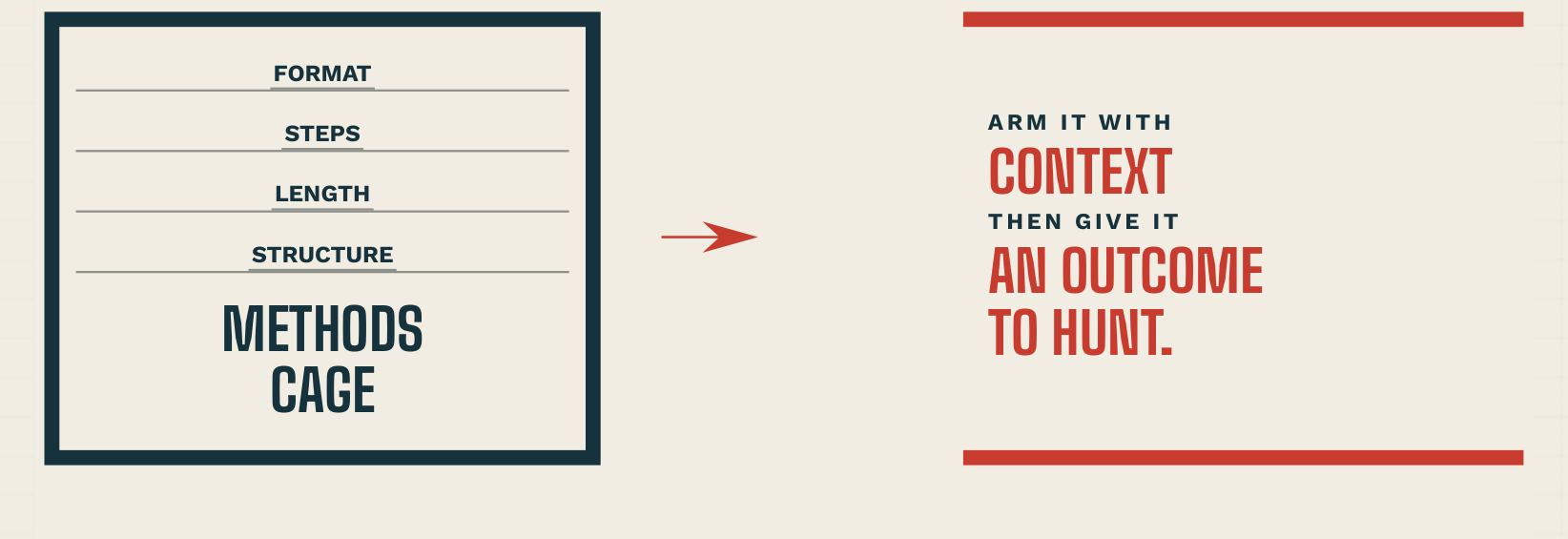
FIX ONE: STOP TELLING THE AI HOW TO DO THE JOB
Every instruction you give AI does one of three jobs. It supplies the context: what to read, what to know, what facts and constraints matter.
It dictates the method: the format, steps, structure, and route.
Or it defines the outcome: what the work is for and what must become true when it succeeds. That’s how the 1% instruct their AI.
But that’s NOT how most AI users I work with instruct AI.
You give the AI almost no context, no real outcome, and a prison full of method. “Write a follow-up email. Under 150 words. Two paragraphs. Use bullets. Make it friendly but professional. Clear call to action. Add a P.S.”
That’s METHOD prompting.
That’s telling AI how to do its job.
And while it looks precise (as method instructions often do)...
You’re giving AI no destination (no real OUTCOME).
So what happens?
The AI follows your instructions to a T and returns a clean little template no one remembers.
It does EXACTLY what you told it to do... then you complain you got “AI Slop” back.
It’s frustrating... and I get it. I hate slop as much as you do. That’s why, what I’m suggesting you do, is give your AI the same job... but instead of telling it exactly what to do...
Simply give it context, very little method, and a clear outcome:
”Here is Tuesday’s call and the proposal. Write the follow-up. Success means he feels we heard the hesitation he never said out loud and replies to book Thursday. If he will never buy, surface that now instead of letting this drag for a month. Format and length are your call.”
Same AI model. Same task. Yet clearly a different demand. In other words, a different outcome.
The first prompt asks the AI to obey your route. The second asks it to hunt for the best way to get the result.
And THAT, my friends, is when your AI starts finding moves you can’t see... and sometimes giving you results you never knew were possible. So if you get nothing else from this report, get this:
METHOD PROMPTING PUTS YOU IN A CAGE. OUTCOME PROMPTING SETS YOU FREE.
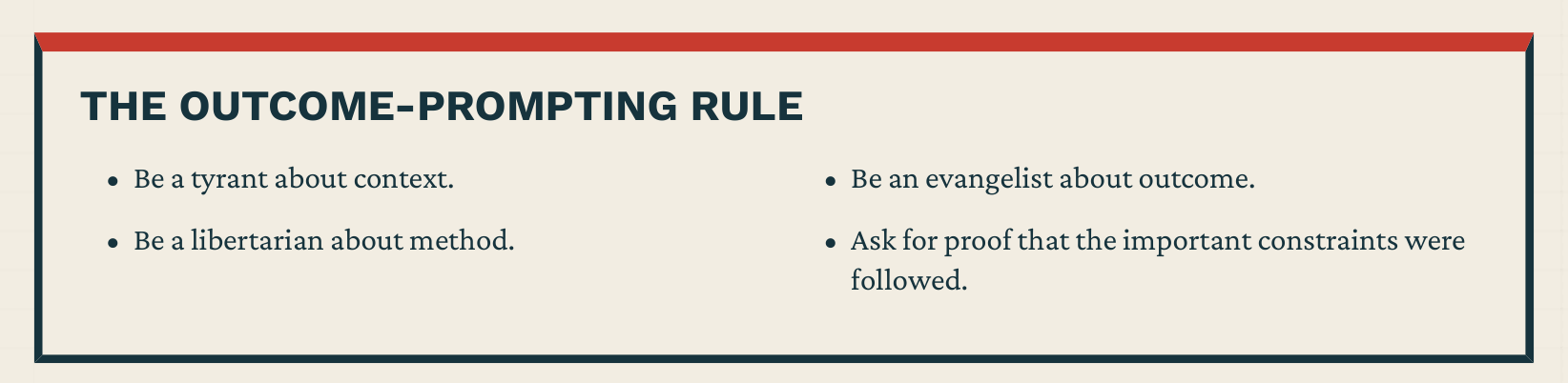
So I insist... be a tyrant about context. If the source matters, make the AI read it. If a fact can’t be invented, say so. Ask your AI for proof - read receipts and other novel ways to confirm your context was consumed.
Notice. I didn’t say ask your AI to confirm it followed YOUR steps. I said, confirm your context was consumed, ingested, and understood before it goes hunting for the ultimate outcome.
Because if you want your AI to accelerate your growth, you have to be a libertarian about method. Give the machine room to find a route better than yours. By providing less instructions on method you give your AI more opportunity to find better solutions to provide bigger and better outcome.
So be an evangelist about outcome. Tell it what the work must change, what the customer should feel, and what should happen next. The clearer and more specific you can be about the outcome, the higher the probability you’ll get it.
The outcome is not the final link in the chain. It is the starting point. Once the outcome is clear, the right inputs become obvious and the AI can use its full intelligence to get you the result.
The best part of making the shift from method based prompting to outcome based is how you quickly realize you’ve just shifted your limits.
It literally takes you from being limited by skill...to being limited only by the full extent of your imagination.
It’s hard to convey in words how liberating this is. Most of us have lived our entire lives confined to thinking our creativity or achievements were bounded to skill. But removing that limit means your IMAGINATION now determines what you can build, how far you can grow, and what you can produce.
Here’s an example of outcome-focused prompted looks like:
“Here are our offers and pricing, last 90 days of results, recent sales calls, customer-support conversations, refund reasons, and current projects.
Find the fastest credible path to generate an additional $100,000 in cash over the next 90 days using the traffic, customers, assets, and team we already have—without increasing ad spend, discounting, or damaging customer trust.
The answer may be pricing, positioning, follow-up, conversion, retention, fulfillment—or something I haven’t considered. Don’t assume our current funnel or priorities are right. Choose the route.
Success means one highest-leverage move, proof from the material, what I’m failing to see, and a test we can launch within seven days. If you lack critical context, tell me exactly what’s missing before answering.”
This alone will release energy, motivation, but more importantly processes to accelerate in your business and boost revenue. That said, it’s far from the only thing to fix.
PROBLEM #2: Your AI Isn’t Connected To Your Business—YOU Are Still Its Harness.
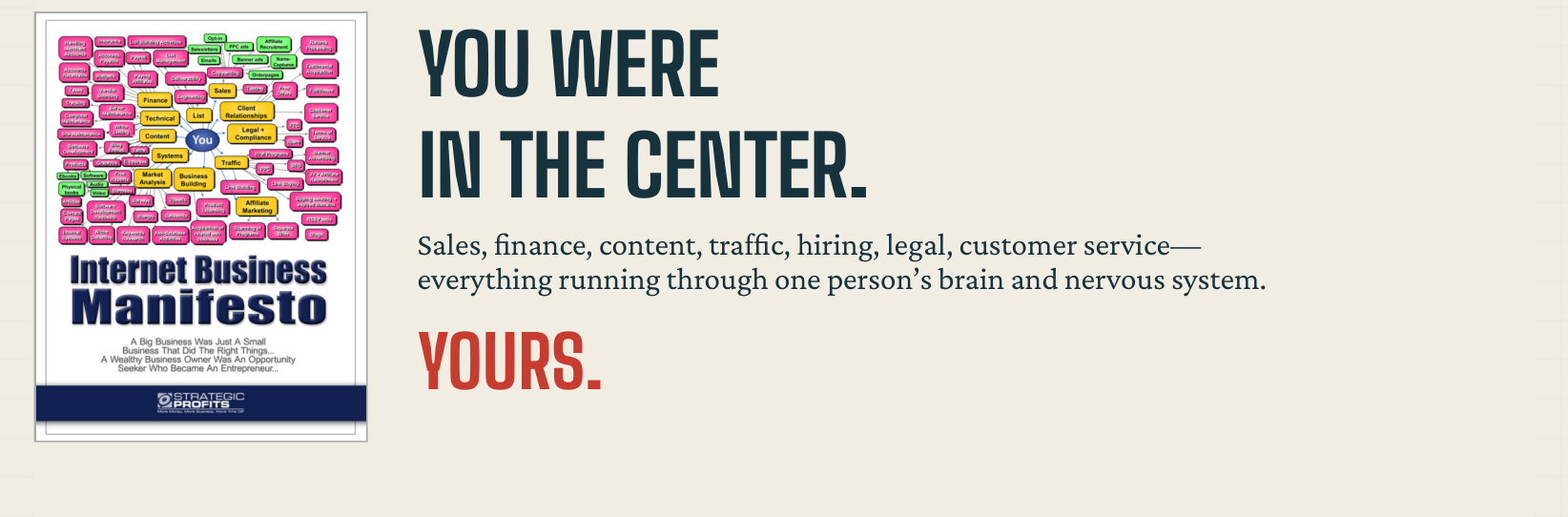
Twenty years ago I published this diagram with one instruction:
Get out—and get out fast.
You were standing in the middle of the business. Sales. Finance. Traffic. Content. Hiring. Legal. Customer service. Every decision, every problem, and every opportunity eventually ran through you.
That made YOU the bottleneck.
So my advice was to get yourself out of the middle.
Today, I’m telling you almost the exact opposite:
Stay in the middle.
But there’s a condition.
You cannot remain the only thing connecting everything.
Because that is exactly how most entrepreneurs are using AI right now. Your AI isn’t connected to your business.
It’s connected to YOU.
It only knows the part of the business you remember to find, gather, explain, and carry to it. It doesn’t see the whole business.
It sees the business through YOU.
Now look at that diagram again. This time, don’t just look at the different parts surrounding you.
Look at the connections between them.
A promise made on a sales call changes what fulfillment must deliver. What happens during fulfillment changes what customer service needs to know. What customers ask customer service should change the marketing. What the marketing promises changes the next sales conversation.
Nothing inside your business operates alone.
And that’s the real problem.
Seven moving parts don’t create seven things to remember. They create an entire web of relationships that must be kept current.
Now add AI.
The AI writing the email sees the email. The one analyzing the numbers sees the numbers. The one reviewing the campaign sees the campaign. Each AI can move incredibly fast with the piece you give it.
But none of them automatically knows what that piece changes somewhere else.
So every new job begins the same way. Find the file. Paste the transcript. Re-explain the offer, the customer, the goal, and everything that changed since the last conversation. Then every output comes back to YOU.
You carry it into the next tool. You supply the missing context. You translate what one part means to another. You catch the contradictions. You decide what changed—and who else needs to know.
You aren’t merely holding information in your head.
You are manually holding the entire business together.
The AI may be doing more of the tasks. But YOU are still managing all the connections between them.
You are the memory.
You are the messenger.
You are the translator.
You are the connection between every piece of intelligence and every place it needs to go.
YOU are still the harness.
That is the hidden bottleneck.
The problem isn’t that your AI lacks intelligence.
The problem is that it has no connected place inside your business to stand.
FIX TWO: GIVE THE AI SOMEWHERE TO STAND
Right now, the AI is standing on YOU. You are functioning as its memory, its connection to the business, and its path from one tool to the next.
That must change.
Twenty years ago, the answer was to pull yourself out of the web. Today, the answer is to give AI a dynamic place inside the web—one connected environment where it can see the business, understand what is changing, and reach the tools required to do something about it.
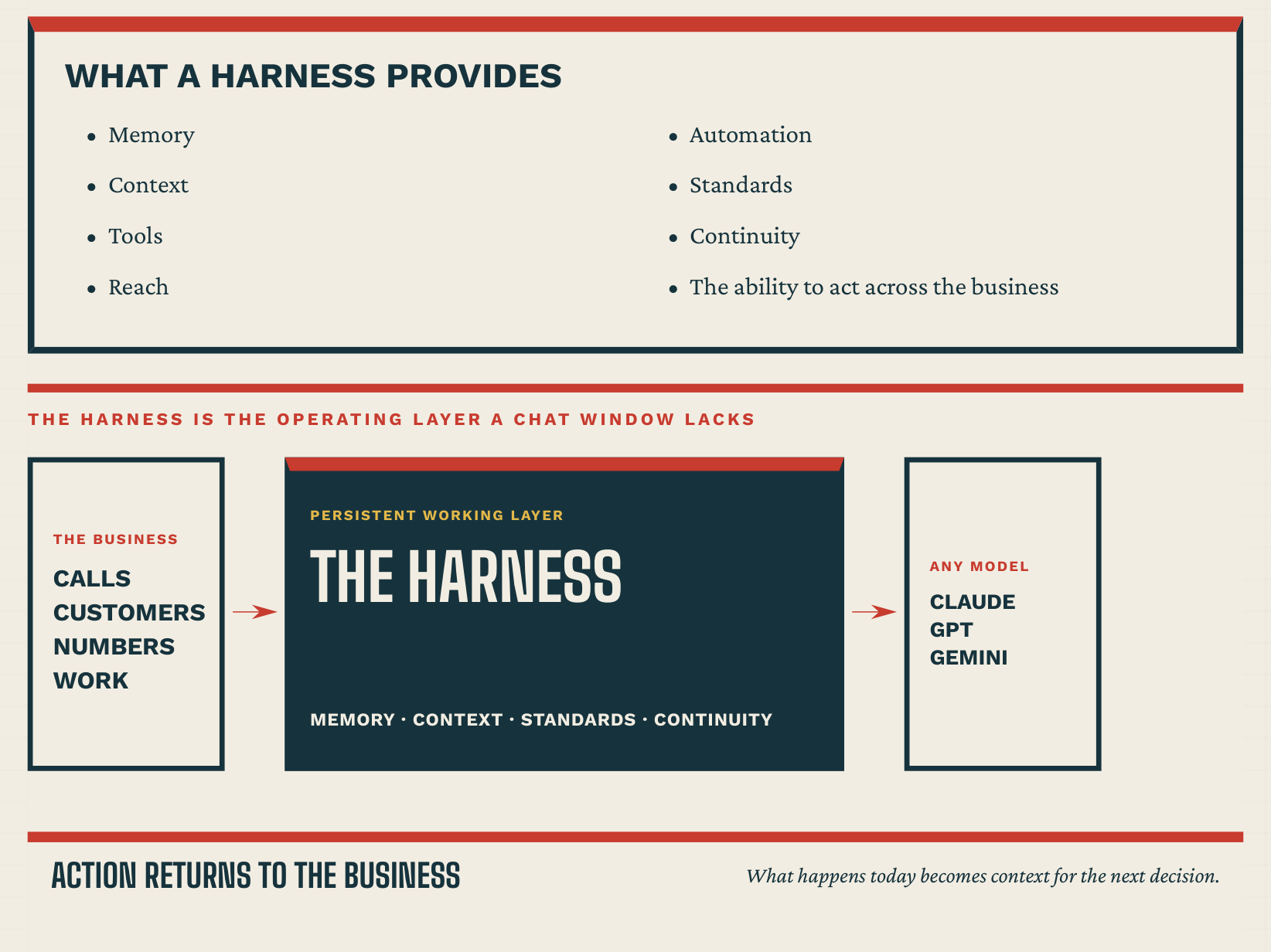
That connected environment is what I call a harness.
FROM CHAT WINDOW TO BUSINESS OPERATING SYSTEM
A harness is not a chat window, a folder of prompts, or one giant dump of files. It is a model-independent operating environment that gives AI memory, context, tools, standards, and a place to work inside the business.
Your offers, customers, numbers, meetings, content, sales history, standards, and work in motion stop arriving as separate briefings. They become one connected business the AI can draw from as the work requires.
That distinction matters.
A folder stores information.
A harness keeps the right information moving.
THE FIVE LAYERS OF A HARNESS
A harness does not give AI one new capability.
It gives AI five layers of capability that work together:
Memory lets it know. Hooks let it notice. Tools let it act. Skills teach it how. Outcome Engines let it own a result. Continuity makes the entire system smarter after every run.
1. MEMORY AND CONTEXT—WHAT IT KNOWS
Memory preserves what the business knows: the decisions, conversations, results, promises, standards, and work already completed. Context selects the part of that memory that matters for the job happening right now. Instead of dumping everything into every task, the harness gives the AI the right information at the right moment.
2. HOOKS, AUTOMATION, AND CONTINUITY—HOW INFORMATION MOVES
A hook is a standing connection between something that happens inside your business and what the AI should know or do next. When a sales call ends, a hook can pull in the transcript, capture the objections and promises, update the customer record, and trigger the follow-up.
When campaign performance changes, a hook can bring in the new numbers, compare them against what was expected, and alert the AI that a decision needs to be made.
The hook notices the event. Automation moves the work forward without waiting for you. Continuity carries the result back into the business so the next decision starts smarter. Nobody has to remember to copy, paste, explain, or transport that information from place to place. The event itself causes the right context to move.
Without hooks, the harness is a library. With hooks, it becomes an operating system.
3. TOOLS AND REACH—HOW IT ACTS
Tools let AI search, calculate, create, update, send, publish, and perform actions beyond the chat window. Reach connects that intelligence to the places where the business actually operates—your CRM, email, calendar, analytics, project management, content systems, and communication channels.
This is the difference between an AI that tells you what should happen and an AI that can help make it happen.
4. SKILLS AND STANDARDS—HOW IT PERFORMS
A skill is a permanent set of instructions for performing a specific job. Think of it as an employee handbook the AI can execute. The skill knows the job. Your standards define what good looks like, which rules cannot be broken, and when the AI must stop and ask for judgment.
That knowledge does not vanish when the conversation ends. It stays available to you, your AI, and eventually your entire team.
5. OUTCOME ENGINES—HOW IT OWNS A COMPLETE RESULT
Then there are systems like the Sales Letter Arena and Webinar Arena. These are not merely tools. They are Outcome Engines—AI departments designed to take responsibility for a finished business result.
The Sales Letter Arena can deploy multiple expert copywriting methodologies against the same brief. Each produces a complete version. Specialized critics evaluate the work. The drafts are revised. A marketplace judge selects the strongest result. And what the system learns can improve the next run.
A tool performs an action. An Outcome Engine owns a result.
Now watch how all five layers work together:
A new offer is approved. A hook recognizes the event. The harness gathers the offer, audience, research, proof, previous results, and standards. The Sales Letter Arena activates. Its specialists compete, critics improve the work, and a winner emerges. The tools publish or route the finished copy. Then the outcome and what was learned return to memory—making the next campaign smarter before it begins.
That is not a folder full of prompts.
That is an AI organization operating inside your business.
The morning’s intelligence can be compiled before you sit down. The right context can arrive at the beginning of each job. Your standards can follow the work wherever it goes. And the result of one action can become the starting context for the next.
Because the harness sits outside the model, I can run Claude, GPT, and Gemini—or replace any one of them—without rebuilding my business around it.
The model can change.
The harness keeps the business intact.
NOW GIVE IT THE WHOLE MAP
Your AI should not only see the meetings, Slack conversations, active projects, marketing calendar - it should also see your CRM, critical data, and sales as they happen. That does not make it magical.
It makes it briefed.
Now it can answer questions no isolated tool can touch:
- Which objection keeps appearing before a refund?
- Which idea from a meeting changed the sales numbers?
- Which campaign looked healthy on the dashboard but had already died inside the team?
And it can act on the answers. An objection from a sales call can change the webinar close. The drop-off at that close can change the follow-up. The replies can change the next sales conversation.
And it can do all of this automatically—without you carrying the context between tools.
Twenty years ago, I taught you to map the business so you could see it whole.
That’s still true.
The difference is that before, you were the only one reading the map.
Now AI can read it with you. That is what makes the five screens on my desk feel like an Iron Man suit. The AI is no longer trapped inside a chat waiting for me to bring the business to it. I set the direction, and the intelligence can move unrestricted through the company.
During a two-day program, former prosecutor Pearl Lockwood used a connected AI setup to build an entire email campaign. By the end of the week it had brought in $25,000.
Not because the model changed.
The full intelligence of AI could finally leverage all of the context and connections within the business - instead of a thin brief.
This is how you go from that exhausting feeling of carrying the business... to effortlessly directing it.
You stop being the tired, worn-out connective tissue between every person, tool, and decision.
The harness carries the context.
The hooks keep it moving.
The intelligence can operate throughout the company.
You set the direction.
KEEP IN MIND - THE HARNESS IS THE PRICE OF ADMISSION, NOT THE PRIZE.
If you want to compete in today’s AI accelerated business environment, you MUST have a robust harness. Your context, tools, integrations, and everything we’ve talked about here in this section are no longer optional.
Just don’t confuse infrastructure with advantage.
Harnesses get easier to build every month. Models are adding memory. Tools that once required custom development can now be connected in minutes. Automations that once took teams can increasingly be created through plain-English instructions. Soon, a good harness—something almost nobody had until recently—will be as ordinary as a good website.
Necessary.
Valuable.
Available to everyone.
The harness is the carrier, not the thing carried.
It can bring your context, workflows, and standards to every job. It cannot render your verdict on one.
Your edge has to come from something no competitor can download with the same subscription.
I’ll take you deeper into what that is in just a moment. First, let’s make sure your new engine is not racing through work that should no longer exist.
PROBLEM #3: You’re Using AI To Speed Up Work That Should No Longer Exist.
You can fix the way you instruct AI. You can give it a harness with memory, context, hooks, tools, skills, and Outcome Engines.
And still miss most of the opportunity.
Because nearly every business begins using AI the same way:
It maps the work people already do—and inserts AI wherever it can make one of those tasks faster.
The email gets written faster. The deck gets built faster. The report gets finished faster. The employee hands the AI-generated work to the same manager, who sends it through the same approval, into the same department, and on to the same next step.
The technology changed.
The design of the work did not.
That matters because many of the tasks, handoffs, approvals, and delays inside your business exist only because people used to be the only intelligence available to carry the work. If AI makes one of those old limitations disappear, the right move is not always to perform the old task faster.
Sometimes the right move is to eliminate the task, collapse the handoff, combine the jobs, or redesign the entire outcome around what just became possible.
Otherwise, you are not building an AI-powered business.
You are making the old business move faster.
FIX THREE: REDESIGN THE WORK BEFORE YOU SPEED IT UP
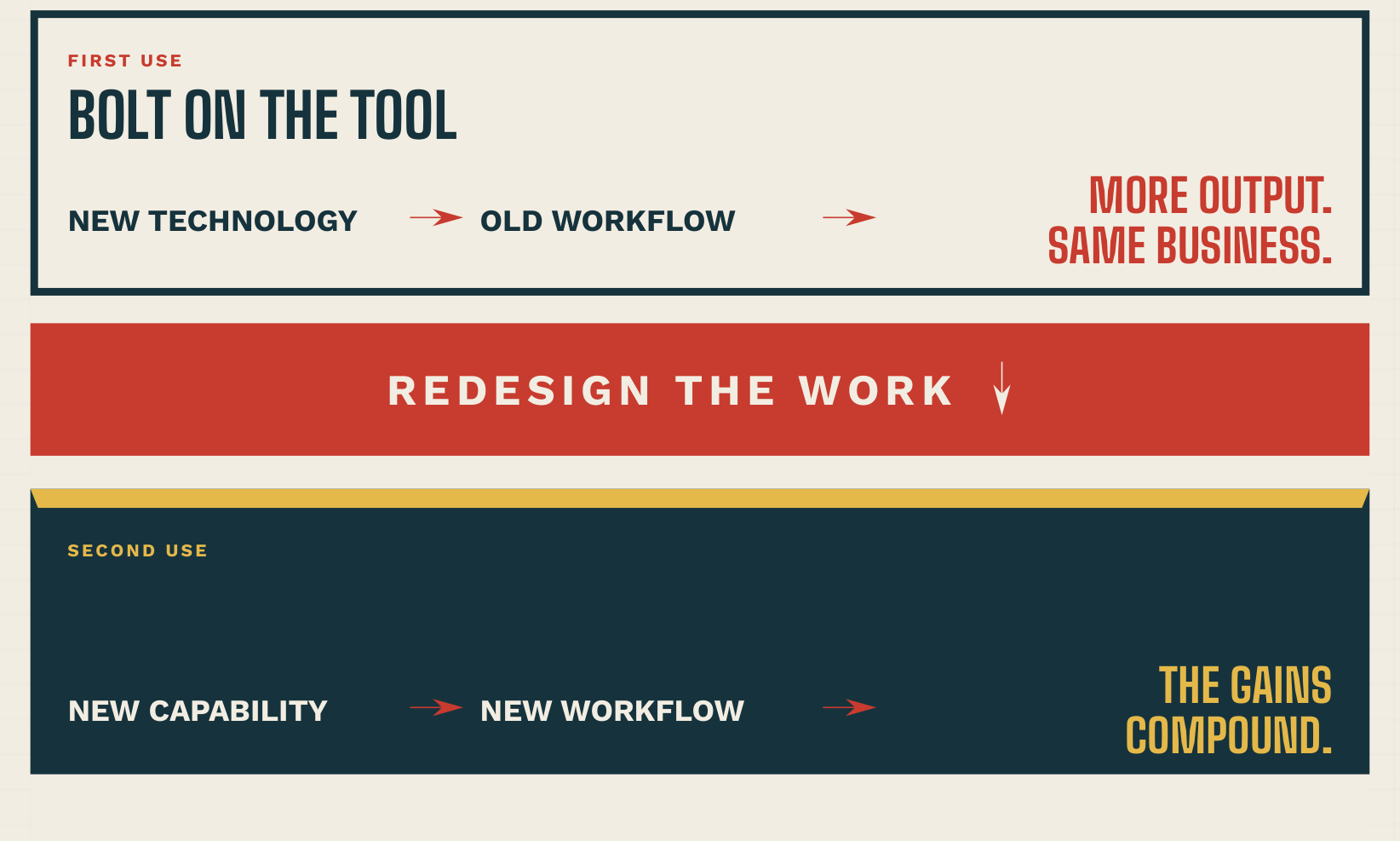
Every major technology gets used twice. First, people bolt it onto the work they already do.
Then someone rebuilds the work around the new ceiling the technology makes possible.
The second person wins.
The automobile began as the horseless carriage. The supercomputer in your pocket is still called a phone. And AI—a machine that can research, reason, create, and act across a business—is called a chatbot, assistant, or operating system. We name the new technology after the old limitation, then use it accordingly.
THE REAL GAINS WAITED FOR THE REDESIGN
The same adoption cycle repeats across every major technology: replace the old tool, preserve the old design, wonder why the gains aren’t exponential as promised—then redesign the system and finally harness the full potential.
Factories did it with electricity.
Owners put a small electric motor on each machine—but left every machine where the steam engine had forced it to be.
New power. Old floor plan. The business barely changed. The real gains arrived when factories redesigned the floor around the flow of work.
Electricity did not merely replace the old engine.
It removed the reason the factory had been designed that way in the first place.
Computers repeated it.
In 1987—already decades into the computer revolution—Nobel-winning economist Robert Solow said, “You can see the computer age everywhere but in the productivity statistics.” Companies replaced typewriters with computers—then printed the file and carried it down the hall because that was what the typewriter-era process required.
The computer replaced the tool.
Nothing around it changed.
The gains arrived when companies rebuilt work around networks, databases, and software—when information stopped following the old paper route.
AI is repeating that cycle now. Companies are adding copilots to old tasks, agents to old handoffs, and generation to old approval chains.
The work accelerates.
The business does not.
Economists call this the Productivity J-Curve: bolt new technology onto old processes and productivity can initially fall because you absorb the cost and disruption without capturing the gain. The curve turns upward only when the work is redesigned around what the technology makes possible.
If you made the first two fixes and AI still is not making you more money, you may be stuck at the bottom of that J.
The prompt changed.
The harness changed.
The business did not.
Every time, the technology arrives first. The exponential gains wait for the redesign.
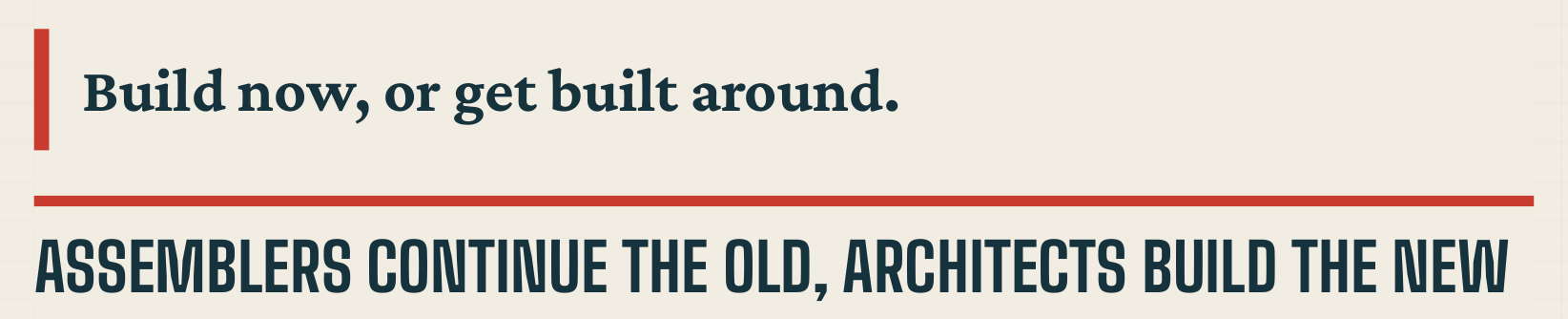
Build now, or get built around.
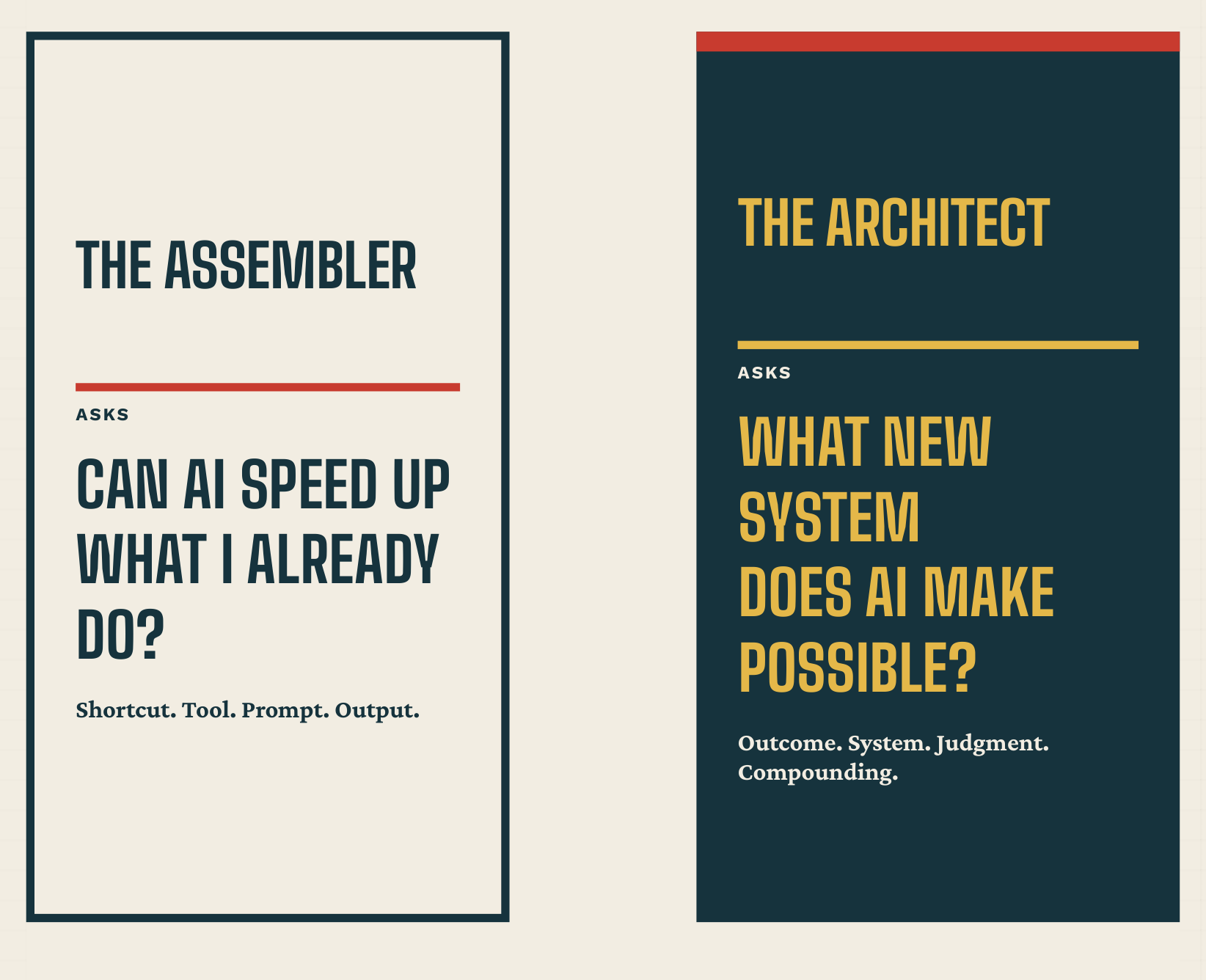
ASSEMBLERS CONTINUE THE OLD. ARCHITECTS BUILD THE NEW.
The original manifesto separated the opportunity seeker from the strategic entrepreneur. AI brought both of them back.
The opportunity seeker became the Assembler.
He aggressively searches for tools and tactics as he bolts AI onto the business he already has and asks:
Can AI do (or speed up) what I am already doing?
The strategic entrepreneur has now become the Architect.
He starts with a different question:
What NEW system, product or entire business does AI now make possible—and what would I build from that?
The question you ask about AI determines the level and profitability of the business you build with it. An Assembler and an Architect watch the same AI build a webinar in an afternoon.
The Assembler sees a shortcut. He wants the tool, the prompt, and the finished deck.
The Architect sees a bottleneck disappear—and starts thinking about how AI can compound the gains he just realized. If the webinar no longer consumes weeks of work with a human building it from scratch, that liberated time can be focused on a bigger vision.
So he asks:
What revenue system becomes possible when building the webinar is no longer the bottleneck?
What must exist around the webinar for it to produce revenue? What is the campaign actually for? Where does his judgment have to enter? What can run without him? What feeds the system—and what should the system feed next? That chain of questions pulls the whole business into view.
That is not the thinking wandering.
That is the thinking working.
Every Assembler question can be answered without changing the business. That is why it feels easy. A question that cannot change anything fundamentally in a system or business cannot be worth very much.
The deck is stacked against the Assembler because every ad, email, and demo answers his one question with a familiar task performed faster.
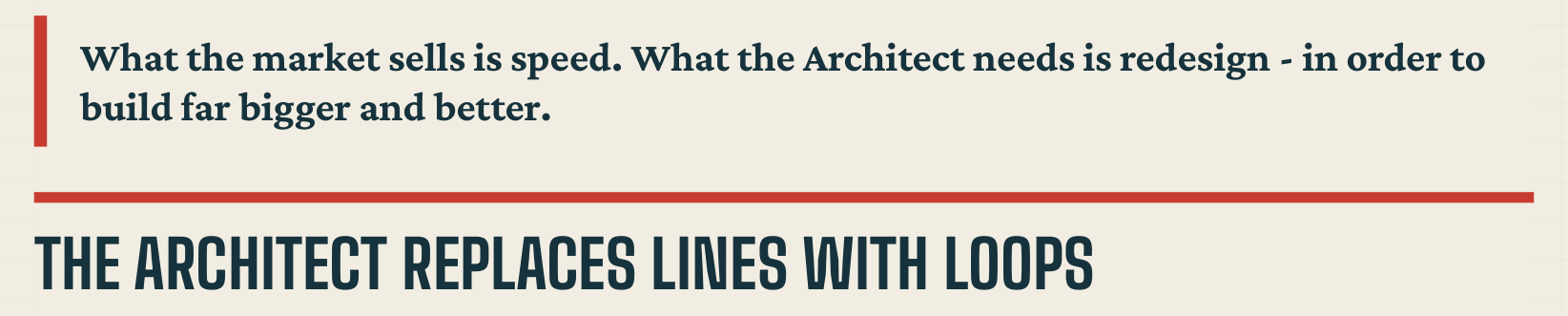
What the market sells is speed.
What the Architect needs is redesign.
THE ARCHITECT REPLACES LINES WITH LOOPS
Most entrepreneurs use AI in a straight line:
TASK → OUTPUT → HUMAN REVIEW → NEXT TASK → STOP
They give AI a task. It returns an output. Then everything stops until someone reviews it, decides what happens next, and creates another assignment. The individual task may be automated.
The business is not.
The Architect replaces that line with a loop:
EVENT → SIGNAL → ACTION → RESULT → BUSINESS UPDATE
An event happens inside the business. AI identifies the signal that matters.
That signal triggers an action.
The action produces a measurable result. And the result creates a business update—changing the memory, rule, workflow, standard, offer, or next decision before the cycle begins again.
That last step is what most automations are missing.
If the result does not change what happens next, you do not have a learning loop. You have an automated line.
In a real loop, the output does not return to you as another task. It becomes the next input for the system.
The AI drafts, checks its work against the standard, revises, ships, reads the response, and uses what it learns to improve the next round.
The email produces replies. The replies update the objections. The objections change the next email. The Architect does not remove himself from every loop.
He deliberately chooses where his judgment matters, which decisions require his verdict, and how far the system can move before it reaches the next human gate.
Between those points, the work keeps moving.
That is the foundation every Architect intelligently builds upon:
Outcomes give the intelligence a destination.
The harness gives it somewhere to stand.
Loops make the business smarter every time it moves.
Now watch what becomes possible when one ordinary business activity is redesigned this way.
THE CALL HAPPENED ONCE. THE BUSINESS GOT BETTER EVERYWHERE.
I have been holding live Q&A calls for more than twenty years. First they happened on teleseminar and teleconference lines. Later they moved to webinar platforms. Today they happen on Zoom.
The technology kept changing.
What happened after the call barely did. In the early years, I paid someone to transcribe every call. Then someone on my team cleaned the transcript, turned it into a PDF, and posted it.
Eventually, the platforms began generating the transcript automatically. The transcription cost disappeared.
But the process still required a person. Someone on my team still had to download the transcript, clean it up, turn it into a PDF, and post it. All in, it took roughly an hour of paid team time.
The cost came down. The human handoff remained. And after twenty years, one Q&A call still produced one transcript.
Then AI arrived.
And the obvious move was to make the same process faster.
Generate the transcript. Summarize it. Pull out the clips. Turn the best moments into social posts. Create an email. Put the recording in the member area before the day ends.
That is useful.
It is also the second-best hand.
Because you took an event that used to create one piece of content and used AI to create five pieces of content.
You multiplied the outputs. You did not change what the business could learn.
The Architect looks at the same call and asks a completely different question:
What did this conversation reveal that every other part of my business should know?
That question changes what the call is. It is no longer content waiting to be processed.
It is a live stream of customer confusion, desire, progress, resistance, language, proof, promises, friction, and opportunity.
It is a sensor for the entire business. And once AI can understand those signals, route them into the right systems, take action, and measure what happens next, one ordinary call can begin changing almost everything around it.
The first two systems end.
This one comes back smarter.
The Architect decides once what the system should notice, what it may do, what proof it needs, and where judgment must enter. Inside those boundaries, the system investigates, creates, deploys, measures, and improves—returning only at judgment gates.
By the time the call is over, the business has already begun to change:
- Future customers move faster without asking for help. Five similar questions expose one weak lesson, so the system repairs it, publishes the update, and measures whether completion improves.
- One customer’s success story acquires the next customer on social media. The system verifies the result, secures permission, creates the clip, puts it in front of prospects with the same objection, and tracks who buys.
- Every new customer gets a better first week. One friction point reveals a weakness in onboarding, so the system repairs the experience and measures activation, support requests, and refunds.
- The StoryBank grows by three stories before the call ends. Each story I tell is captured, tagged by the belief it can change, and made available to every future email, campaign, lesson, and sales argument.
- The next sales page sounds more like the customer than the company. The system captures the exact words clients use to describe their problems, desires, objections, and results—and tests them in the copy.
- The next prospect gets an objection answered before raising it. A recurring concern becomes an email, FAQ, webinar slide, sales argument, and piece of proof delivered before the next buying decision.
- A promise made in passing gets kept. It becomes an owner, deadline, and proof requirement—then stays alive until the promised result appears.
- A future support ticket disappears before anyone opens it. Repeated confusion triggers a repair to the product, instructions, onboarding, or help center.
- One member’s insight begins helping hundreds of other members. The system captures what unlocked the room, turns it into a teaching asset, and tests that person in a small peer role.
- A repeated desire becomes a validated new offer. The system finds the people who revealed the demand, puts the smallest possible offer in front of them, and lets their response determine what gets built.
- The product roadmap moves toward what customers will actually use. Workarounds, requests, and unmet expectations become ranked opportunities instead of forgotten comments inside a recording.
- The business gets better at attracting the right customers. The system connects what people say on the call with who buys, succeeds, stays, refers others, or asks for a refund—then improves the targeting.
The product improves. Marketing goes live. Sales gets stronger proof. Onboarding gets repaired. Support load falls. Intellectual property compounds. Promises get kept. The community grows stronger. New revenue gets tested. Customer acquisition gets smarter. And the Architect does not leave the call with twelve new assignments.
The business has already begun doing the work.
EVENT → SIGNAL → CREATE + ACT → DEPLOY → RESULT → BUSINESS UPDATE → BETTER NEXT OUTPUT
The Q&A call is not the point. It is the smallest example. Replace it with a sales call. A refund. A launch. A customer win. A support ticket. A failed campaign. A correction you make to an employee or an AI.
Every day, events produce a result and die where they happened.
The Architect asks one design question:
What happens once in my business that could make everything else smarter?
Then he builds the loop that allows the system to surface the questions, answer them, act, and learn from what happens.
The Assembler multiplies outputs. The Architect turns every event into action—and every result into a smarter business.
BEFORE THE NEXT WAVE: WHAT YOU CAN DO NOW
You can now:
- Move from skill to imagination. Break the Methods Cage. Arm AI with context. Give it outcomes to hunt. Then let it find a better route than the one you knew to prescribe—so what you can build is no longer capped by what you already know how to do.
- Move from the chat window to a business operating system. Give AI somewhere to stand: a Harness with memory, context, reach, continuity, standards, and the ability to act—so it can carry real work across the business while you set the direction.
- Move from Assembler to Architect. Redesign the work before you speed it up. Replace lines with loops that act, measure, learn, and improve—so one activity can strengthen the entire business and growth no longer requires the same people, handoffs, and hours.
Put those three shifts together and your existing business can do things it could never do before. New opportunities open. Entirely new businesses become possible. And growth no longer has to demand more staff, more capital, and more of you.
As valuable as all of that is, if that were all I had to tell you, I would not have written this manifesto.
Everything in the First Wave is already possible. Entrepreneurs and businesses at the leading edge are doing it now.
I had to show you how to capture what is possible now... before I could show you how to secure your advantage in what comes next.
This wave is about the only AI advantage that will remain.
Models will get more powerful.
Memory will expand.
Tools, agents, skills, and harnesses will multiply. Soon, your competitors will be able to rent the same intelligence, install the same capabilities, and build on the same infrastructure you can.
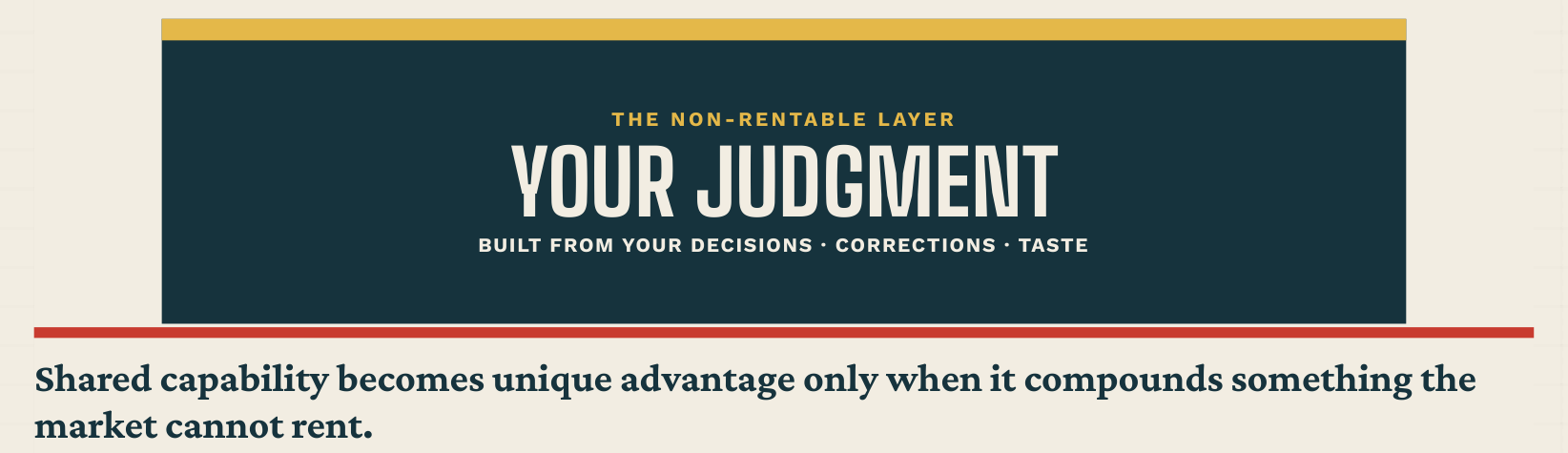
But they will never have access to your judgment.
That does not make your judgment an advantage yet. Not while it lives only in your head.
Not while it disappears after every decision, correction, and exception.
And not if you wait.
A competitor can install next year’s model next year. They can copy your tools. They can build the same harness.
They cannot go back and capture the judgment you failed to preserve this year.
For the first time, AI can learn how you judge from the work you already do.
Every decision can teach it.
Every correction can sharpen it.
Every exception can reveal something no rule ever could.
Over time, that judgment accumulates.
Then AI can carry more of you across the business.
It can make more of the calls you would make. It can improve work you never personally touch.
It can build things the old you never had time to build.
Everyone will be able to rent the intelligence.
Only you can build the judgment it operates with.
Why does judgment matter so much?
AI can give you a thousand possible moves.
Judgment decides which one is worth making.
It chooses the breakthrough idea worth pursuing.
The marketing worth transforming.
The business worth building.
The more capable AI becomes, the more possibilities it can create. That makes judgment more valuable—not less.
Judgment is not a soft skill. And it is not the end goal.
It is how you direct everything else—your models, memory, context, harness, and outcome focus—toward something uniquely valuable. When intelligence and execution become abundant, knowing what is worth doing becomes priceless.
That is where the revenue, the margin, the breakthrough, and the change in your life actually come from.
The Real Exponential Opportunity of AI
Until now, everything you learned the hard way—the scars, the expensive lessons, the pattern recognition—could travel only as far as you could personally carry it.
One room.
One problem.
One decision at a time.
AI changes that.
It can capture, codify, and operationalize your judgment—then carry it into work you never personally touch.
More decisions can reflect how you think. More customers can receive the best of you.
More systems, products, and businesses can be built from what only you know.
The real exponential opportunity of AI is turning what you learned once into an advantage your business can use everywhere.
STOP PAYING THE FINAL TWENTY TWICE
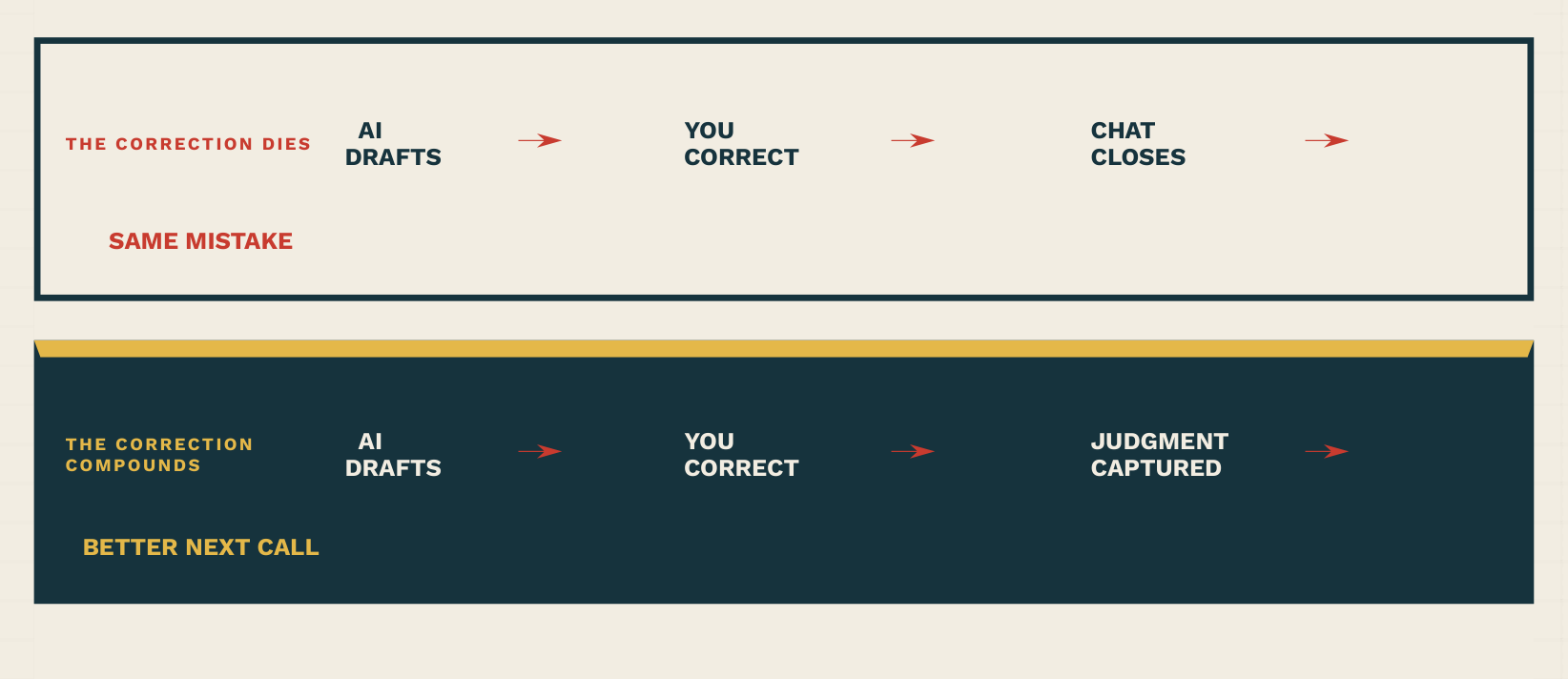
The First Wave showed you how to get AI doing useful work now. The first eighty percent may arrive in seconds.
Then you spend your judgment correcting the final twenty.
The result gets better.
But the correction disappears with the chat.
The next job begins. AI makes the same kind of mistake. And you pay the final twenty all over again.
The Second Wave ends that cycle. Not by getting AI to use your judgment once.
By giving that judgment somewhere to accumulate—so every real correction improves the next decision, even when you are not there to make it.
That is the difference between an assistant that saves you time and a system that compounds you.
One returns hours.
The other turns the choices behind your best results into an asset your business can use again and again.
Before I show you how, I need to tear apart the advice I spent twenty years teaching.
AI JUST REVERSED THE ADVICE I BUILT MY CAREER ON
On June 22, 2006, I posted the Internet Business Manifesto on my blog. By my count, more than five million people downloaded it. It became one of the earliest lead magnets to go viral.
Its message was simple:
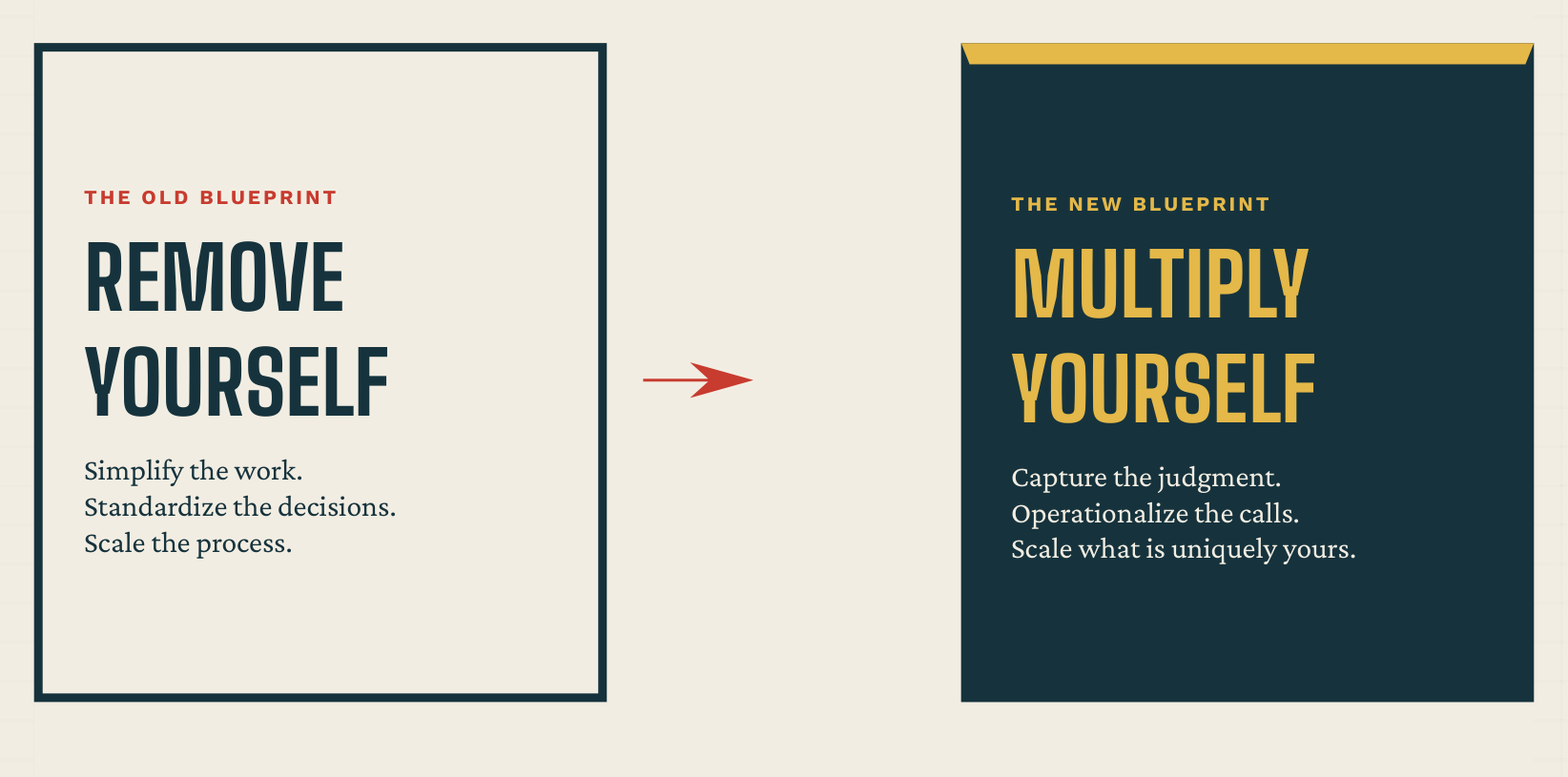
Stop being the bottleneck. Build the systems. Take yourself out of the work.
That advice built real companies.
It gave owners time, scale, and freedom.
I stand behind it.
But the times have changed.
For twenty years, scaling meant removing whatever made the business depend on you.
Simplify the work.
Streamline the process.
Standardize the decisions.
Document the steps.
If something depended on your unique judgment, turn it into a rule—or take it out of the workflow. That was how you made the business repeatable without you.
THE OLD BLUEPRINT REMOVED YOU. THE NEW ONE MULTIPLIES YOU.
AI changes that tradeoff.
It can scale work that once had to be simplified and standardized.
AI does not need your judgment to produce competent work.
And it can do it fast. But it can do the same for every one of your competitors.
When competent execution is available to everyone, competence becomes the baseline.
The advantage moves from doing the work to deciding what the work should become.
Your judgment chooses the vision.
Superintelligence expands what can be built from it.
And once your judgment is operationalized, AI can carry that vision across the business—even when you are not there.
More of the business can reflect the best of you. The more capable AI becomes, the more leverage your judgment gains.
So the new blueprint is not “stay trapped in every task.”
It is sharper than that:
Stop removing yourself. Multiply yourself. Scale your judgment throughout the business—not merely your processes.
KLARNA AUTOMATED THE WORK BEFORE IT CAPTURED THE JUDGMENT THAT MADE IT WORK
In 2024, Klarna announced spectacular results from its AI customer-service assistant. It was handling two-thirds of its support chats.
Doing work equivalent to 700 full-time agents.
And cutting resolution time from eleven minutes to less than two. During the same AI push, Klarna’s workforce fell from roughly 5,000 people to 3,800—mostly by leaving vacated positions unfilled.
Fewer people.
Lower cost.
Faster answers.
The metrics looked great.
Then, in 2025, Klarna’s CEO acknowledged that the focus on cost had produced lower quality. Customers, he said, should always be able to reach a person. The obvious lesson is that AI should handle routine issues while humans handle the difficult ones.
That is true.
But it is too shallow.
The deeper mistake was not handing work to AI.
It was reducing the people carrying the judgment before the system had captured what they knew.
For a financial company, customer service is not a side function. It is where trust in the product gets tested.
The best support people knew when a technically correct answer would destroy that trust.
When an exception mattered.
When a customer needed a human response—not merely a faster one.
Those calls were written in no policy, handbook, or system.
So when the people left, their judgment left with them.
The model did not fail.
The sequence did.
Klarna automated the execution before it preserved the judgment that made the execution work.
AI IS MAKING EVERYTHING RENTABLE EXCEPT YOUR JUDGMENT
In 2018, three University of Toronto economists made the economics of AI legible in Prediction Machines.
Their thesis was simple:
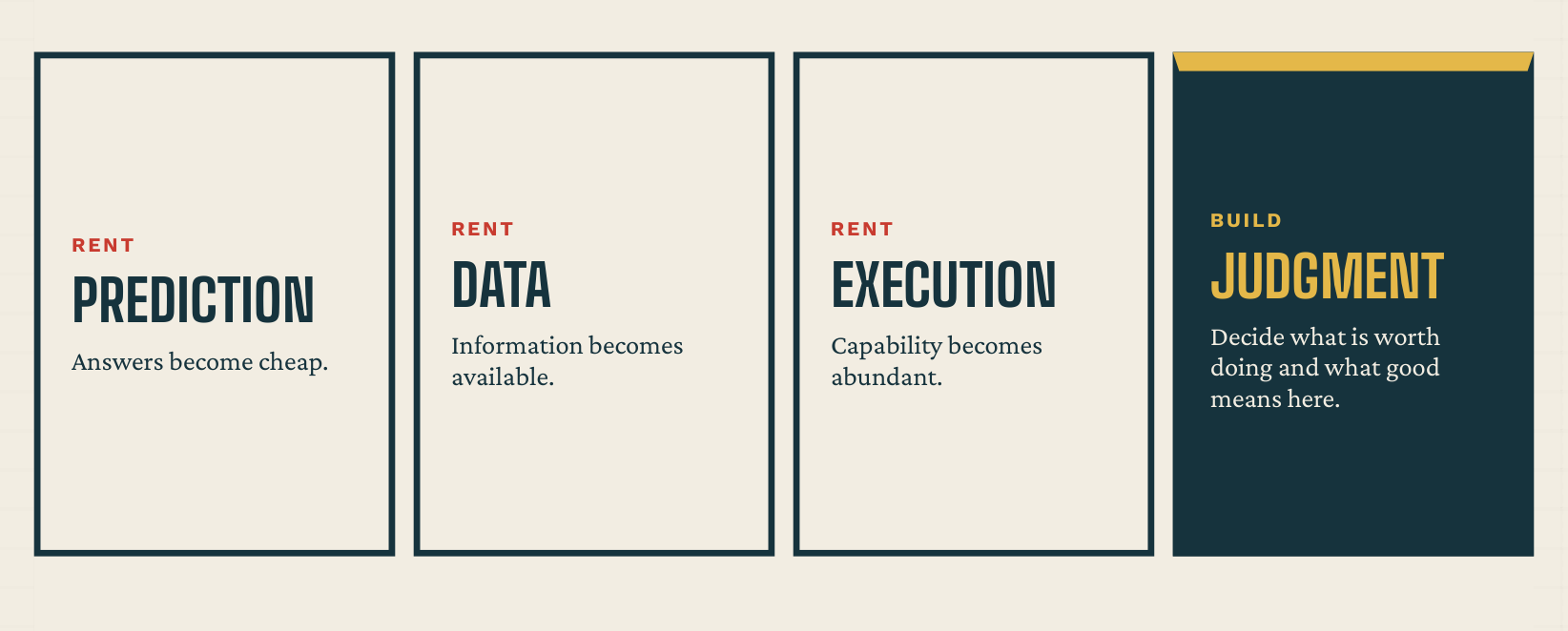
When AI makes prediction cheap, the things surrounding prediction—data, judgment, and action—become more valuable.
They were right.
But AI kept moving.
Prediction was only the first capability to become abundant.
Now data is increasingly accessible.
Execution is increasingly automated.
And the same models, memory systems, tools, agents, and harnesses will become available to almost everyone.
Prediction gives you answers, possibilities, and recommendations.
But you rent that intelligence from the same companies your competitors use.
Data gives AI something to work with.
Your private customer behavior, business history, and live results still matter enormously. But data does not interpret itself. It cannot decide what matters, what something means, or what should happen next.
Execution turns a decision into action.
Work that once required hours, specialists, departments, and handoffs can increasingly happen in minutes.
That does not make execution unimportant.
It makes capable execution abundant.
One by one, the inputs businesses once competed to control are becoming available to everyone.
Prediction tells you what could happen. Data tells you what has happened.
Execution makes something happen.
Judgment decides what should happen.
That is where you come in.
The models know the generic structure of business.
They do not know your version of it.
Your history. Your scars. Your customers. Your standards. Your pattern recognition. Much of that was never written down. It could not have appeared in any training set because it existed only inside the calls you made.
Your competitors can rent the same capabilities.
They cannot rent the judgment that determines what those capabilities are worth.
THE MARKET WAS PAYING FOR JUDGMENT ALL ALONG
Earlier, I promised you the receipts.
Here they are.
Five worlds that agree on almost nothing—all placing serious money or real consequences on the judgment of one particular person.
Venture capital bets on the founder.
Slack began inside a failed game company. Instagram began as a cluttered check-in app. The idea is allowed to be wrong.
Because venture capitalists are betting on more than the idea.
They are really betting on the founder’s judgment.
Can this person recognize when the idea is wrong?
Can they find the better move before the money runs out?
The operating table prices the surgeon.
One study examined nearly half a million patients across eight major operations. In some operations, patients treated by surgeons with less experience—and less hard-earned judgment—were nearly four times more likely to die.
The procedure was known. The steps were standardized. The operating room was governed by protocols and checklists.
The outcome still changed depending on who held the scalpel.
The corner office measures the person.
Researchers measured how much of a company’s performance could be traced to the individual CEO. In 1969, it was roughly eight percent.
By 2009, it was nearly twenty percent.
During those forty years, management technology improved beyond recognition. If better tools made the person less important, that number should have fallen.
It didn’t.
As technology improved, the person in charge mattered more.
And CEO pay rose as if the market knew it.
The actuarial table prices the person.
Businesses buy key-person insurance to protect themselves from losing one individual.
Every premium is a confession:
The org chart may describe the role.
The balance sheet knows the person’s judgment cannot be replaced.
The recording studio pays for taste.
Rick Rubin has said that he has no technical ability and knows nothing about music.
So what are artists paying for?
His confidence in his taste—and his ability to express what he feels.
The equipment was not the scarce input.
His point of view was.
AI has every point of view—which is the same as having none.
It needs yours.
Your judgment creates value.
AI gives it scale.
VALUE AT SCALE = WEALTH.
Venture capital. The operating table. The corner office. The actuarial table. The recording studio. Five different ways of measuring value.
All five reach the same conclusion:
The valuable thing was never merely the work. It was the judgment of the particular person doing it.
“IF MY JUDGMENT IS SO VALUABLE, WHY HASN’T IT MADE ME RICHER IN THE AGE OF AI?”
Because until now, your judgment had a hard limit:
One location.
The founder could sit in one meeting.
The surgeon could stand at one table. You could review one campaign, one hire, or one deal at a time.
If the person left, the judgment left.
If the person stayed, the business paid in dependence, delay, and limited reach. That is the trapped tax—the premium a business pays when its most valuable intelligence can only be used wherever one person happens to be.
Systems reduced that tax.
Training reduced it.
Great teams reduced it.
None could eliminate it because the most valuable judgment was often the hardest to explain.
What made your judgment difficult to scale is exactly what now makes it so valuable to capture.
WE KNOW MORE THAN WE CAN TELL
Michael Polanyi was a scientist and philosopher who spent his career studying how human beings know what they know.
He distilled the problem into eight words:
We can know more than we can tell.
He called it tacit knowledge.
You may know it as unconscious competence.
You know what to do.
But you cannot fully explain how you know—or reduce it to exact steps someone else can follow. The surgeon’s hand recognizes a pressure no paragraph can teach.
The negotiator feels the moment to stop talking.
You can read a proposal that checks every box and know the deal is wrong before you can explain why. In each case, the judgment arrives before the explanation.
Sometimes the explanation never arrives at all.
WHY MASTERY HAS ALWAYS REQUIRED APPRENTICESHIP
That is why the deepest craft has always moved through apprenticeship.
Place the novice beside the master.
Then let the novice watch.
Not for a week.
For years.
The routine cases arrive quickly. Those can be learned in months.
What takes years is waiting for the exceptions.
The strange customer.
The misleading symptom.
The one case where the standard move is exactly wrong. The master sees it and does something unexpected.
The apprentice captures one more piece of a pattern no manual could hold.
For most of history, that was the lock. Tacit judgment could move only through proximity.
Someone had to be standing there when the master made the call.
There was no reliable way to capture the complete judgment event as it happened. Either someone was there to learn from it—
or the judgment remained trapped inside the person who made the call.
THE RIGHT AI SYSTEM CAPTURES YOUR JUDGMENT EFFORTLESSLY
At this point, an unpleasant question usually appears:
“So now I have to stop everything and train AI on my judgment? I’m already behind.”
No.
The right system does not ask you to sit down and explain everything you know.
You couldn’t do that anyway.
That is what makes tacit knowledge tacit.
Your judgment becomes visible in the work you already do.
When you approve something.
Reject something.
Correct something.
Make an exception.
Or explain why something technically correct is still not good enough.
This client, under these conditions: yes. That promise, in this market: no.
This draft is technically correct—but still not good enough. Here are the three reasons why.
Each decision or correction makes your hidden knowledge visible for a few seconds.
That is all AI needs.
The right harness recognizes those moments automatically. It captures what was in front of you. The surrounding context. The call you made. The reason behind it. And what happened next.
Then it brings that pattern forward when a similar situation appears.
You do not stop your work to train the AI.
The work you were already doing trains it.
You are the master.
AI becomes the apprentice that can stand beside you every day, remember every correction, and carry what it learns into work you never personally touch.
YOUR IMPRINT: CAPTURED, NOT GUESSED—YOUR MOST VALUABLE ASSET IN THE AGE OF AI
I call it your Imprint.
Your judgment, captured.
Captured deeply enough for AI to understand it.
Act on it.
And multiply it.
This is not an archive.
A chat history.
Or a profile AI assembled by guessing who you are.
Your Imprint is a living system.
It automatically captures your thinking, perspective, decisions, corrections, and judgment while you work. And in a moment, I am going to give you a complete system that does exactly that.
Nothing to buy.
No extra training hours.
It works around you so that, eventually, it can work for you.
Capture is where your Imprint begins.
But the complete Imprint goes much further.
No competitor can buy it.
No model can generate it.
No vendor can own it unless you hand it over.
Remember the harness?
Your harness gives AI the models, tools, memory, context, rules, and access it needs to operate.
Your Imprint gives all that power your judgment.
The harness expands what AI can do.
Your Imprint determines what it does with that power.
AMAZON COULD SCALE EVERYTHING EXCEPT BEZOS’S JUDGMENT.
Jeff Bezos had been trying to solve this problem for years before AI could do anything about it. Bill Carr was Bezos’s number two at Amazon.
Carr said Bezos obsessed over how to “actually inject his lens of thinking into all those meetings” across the company.
Bezos understood what that could do. If his judgment could be present in every meeting—even when he wasn’t—the quality of thousands of decisions could change.
And when thousands of decisions improve, the entire company improves with them.
Change the judgment inside the meetings, and you change the company those meetings create.
Bezos was not merely trying to distribute policies.
Or procedures.
He was trying to distribute his lens.
His Imprint.
If any company on earth should have been able to solve this, it was Amazon. It may be the most systemized company ever built.
Amazon created leadership principles, six-page narratives, tenets, working-backward documents, and process after process to make Bezos’s thinking travel without him.
Those systems carried a great deal of it.
But every one of them had the same limit:
They could carry only what Bezos managed to put into words.
They could preserve his stated principles. They could not capture his judgment at the moment he used it.
Everything else still lived inside Bezos.
The Imprint was there.
The machine capable of capturing it wasn’t.
Now it is.
WHEN INTUIT’S BEST JUDGMENT REACHED 5,179 PEOPLE
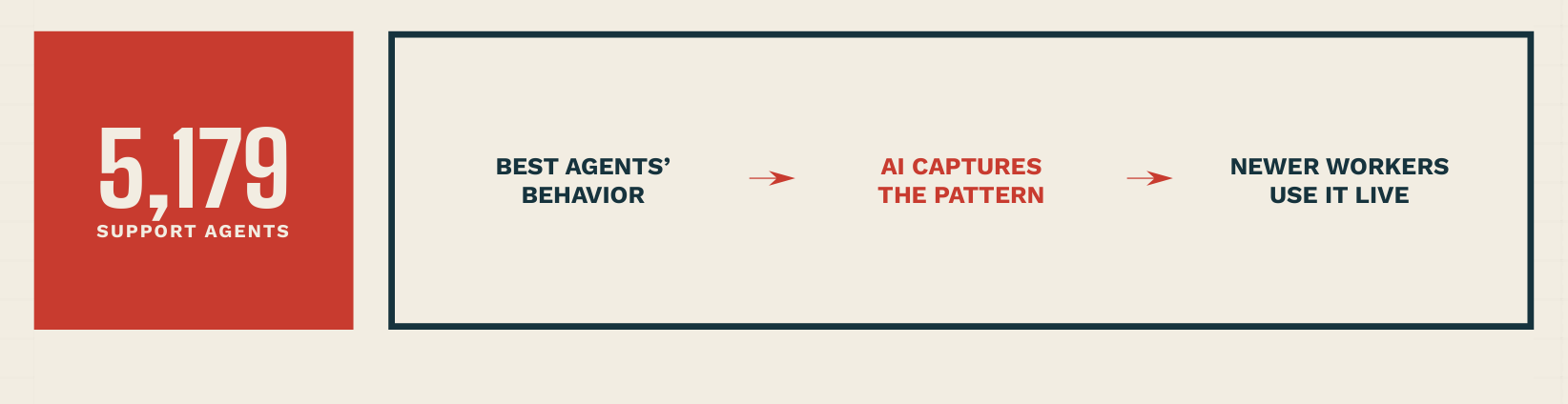
Intuit placed an AI assistant beside 5,179 customer-service agents. The AI had learned from millions of successful and unsuccessful conversations.
Then it began carrying what it learned into every new conversation.
Productivity rose fourteen percent across the operation. Among the least experienced agents, it rose as much as thirty-five percent.
Within four months, employees using the system were outperforming people who had been on the job more than twice as long.
Customer sentiment improved.
Employee retention improved.
But the real breakthrough was hidden inside the conversations.
The AI had learned the behaviors of the company’s best agents. Then it delivered those behaviors to newer employees in real time—inside calls the experts would never personally hear.
Practices that had been difficult to explain in a training manual were suddenly available at the exact moment someone needed them.
This was not a complete Imprint. It did not capture an owner’s judgment across an entire business.
But it proved the economic move underneath one:
AI can learn from the judgment behind superior performance. It can carry that judgment beyond the people who developed it.
And when it does, measurable business results change.
The best agents were still in one place.
Their judgment no longer was.
STOP TRYING TO UPLOAD YOUR TASTE. GIVE AI SOMETHING TO TASTE.
Ask an expert to explain their complete judgment.
They usually hesitate.
Not from false modesty.
They cannot fully explain it.
But put a specific case in front of them?
The answer often arrives immediately.
So stop trying to upload your taste.
Give AI something to taste.
Monday, the AI writes a headline. You reject it: too clever, promise buried, sounds like the category instead of us. Tuesday, it proposes an angle. You correct it: true claim, wrong tension; the customer is afraid of wasting another year, not another thousand dollars.
Wednesday, it drafts the close. You pull the pressure out because this audience protects autonomy and pressure will cost the sale.
By Friday, the system can begin recognizing the pattern you keep correcting. A month later, the first pass can begin where the third used to begin. You never wrote a theory of your taste.
You spent your judgment on real work.
Your Imprint made sure that judgment carried forward.
RULES PRESERVE INSTRUCTIONS. VERDICTS REVEAL JUDGMENT.
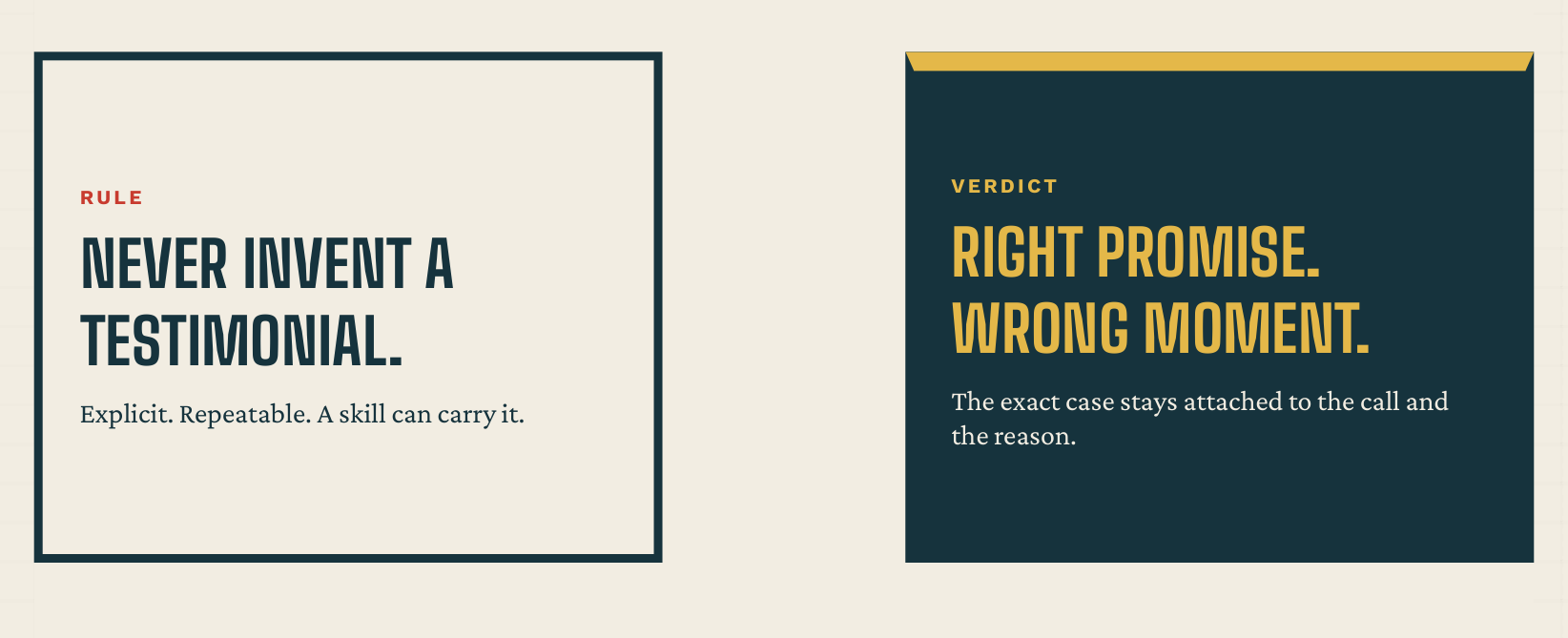
Some corrections are rules: Never invent a testimonial. Use the customer’s exact numbers. Put the guarantee after the mechanism. Write those down. A good skill can carry them.
The more valuable corrections are verdicts: This is trying too hard. That is the right promise at the wrong moment. I trust this person—but not that proposal.
Rules tell AI what to do.
Verdicts show AI how you judge a specific case—especially when the rule alone is not enough. A verdict may look small. A yes. A no. A five-word correction.
But when the exact situation stays attached to the call you made, AI can begin learning why you made it.
That distinction matters.
Show AI only the finished sales letter and it can come up with hundreds of possible reasons it turned out that way.
Was the short opening about urgency, the audience, your voice, the channel, or a deadline?
The output is the answer with the question torn off.
A captured verdict keeps the question and answer together:
This opening, for this audience, under this objective—no, because it performs intelligence instead of creating recognition. Situation and call. Input and judgment.
One pair teaches very little. Enough pairs begin revealing a pattern without forcing you to turn that pattern into a rule. That is how apprenticeship has always worked. The master did not explain a rule for every possible exception. The apprentice watched enough real cases to begin seeing what the master saw.
But an AI apprentice has an advantage:
It does not have to wait years for the right cases to appear. It can place two offers in front of you. Compare two clients who look equally good on paper. Find past decisions that seem inconsistent. Then it can bring those cases to you for confirmation or correction.
That confirm-or-correct step is not politeness. It is the mechanism.
Your confirmation tells the system the pattern still holds. Your correction tells it what changed.
Without your verdict, the system can only guess.
THE FIRST PROMPT MATTERS. THE FEEDBACK MATTERS MORE.
In the First Wave, outcome prompting moved the limit from what you already knew how to do to what you could imagine. You no longer needed to know the method.
You needed to define the result.
That changes more than what AI can produce.
It changes what AI can learn from your feedback.
When you dictate the method, your corrections improve the method: use this framework, add another proof point, make the close stronger.
But when you define the outcome, your corrections reveal why the result missed:
This would not move this customer.
The claim is true, but it makes us sound like everyone else.
The pressure will cost more trust than it wins in sales.
The Assembler’s feedback teaches AI to obey.
The Architect’s feedback teaches AI to judge.
Those verdicts reveal what you saw, what the first result missed, and what needed to change. The right system captures them automatically as part of the work.
Six months of method feedback can create a more obedient stranger.
Six months of outcome feedback can create a brilliant apprentice.
That is why your Imprint is not another file you prepare. It grows inside the work. Every correction can improve what the system does next time instead of disappearing with the chat.
But those captured decisions cannot remain a flat list.
A LIST REPEATS. A WEB CAN GENERALIZE.
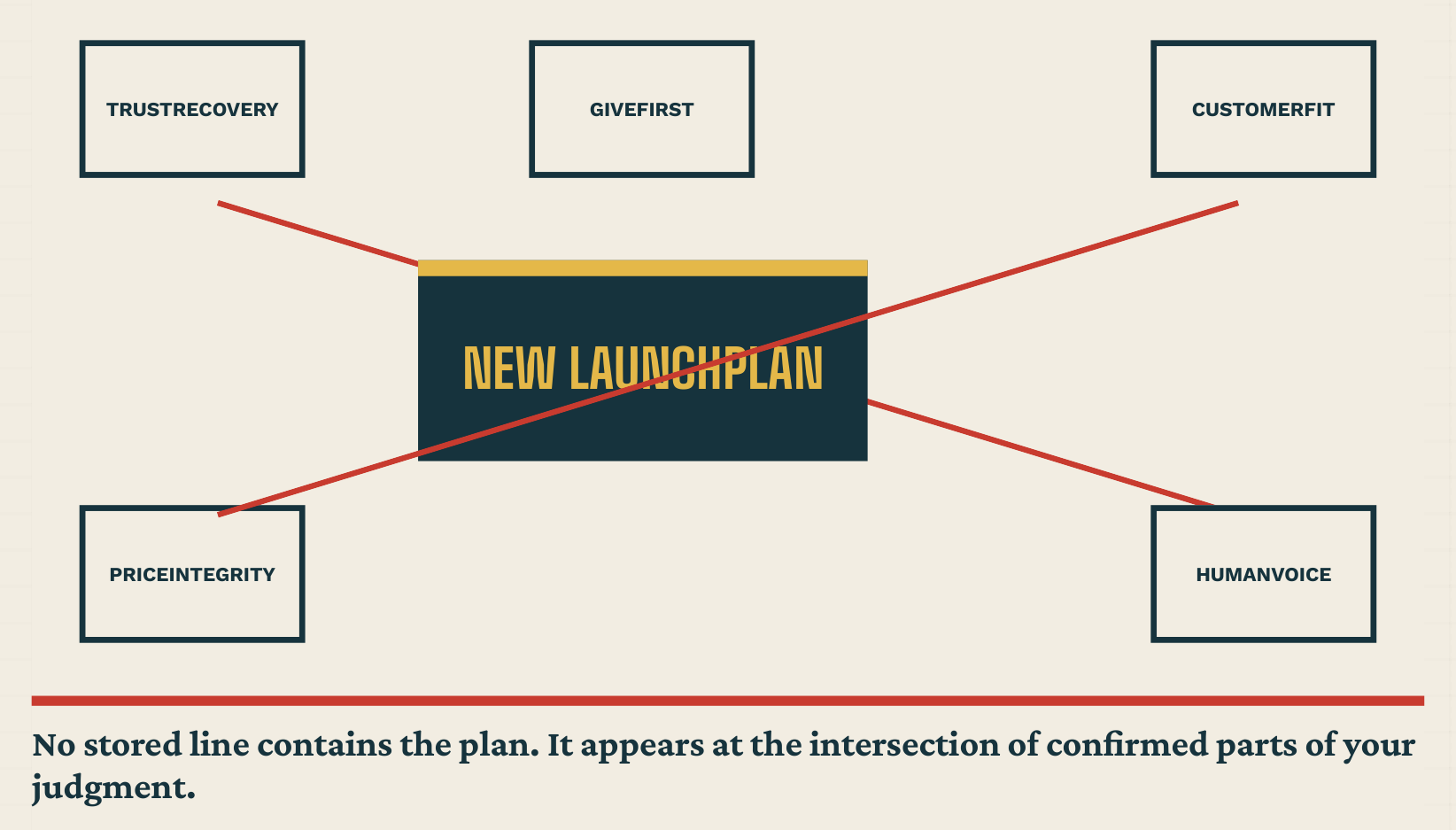
Suppose your Imprint captured five marketing decisions you made months apart:
- After a hard promotion, you waited ten quiet days and sent two value-only emails. Trust needed time to recover.
- You rejected a lower-priced flagship tier because the price was part of the promise.
- You refunded a five-figure sale because the buyer was wrong for the program.
- You opened a campaign by naming who should not buy because fit mattered more than volume.
- You killed the clever subject line and chose five plain words because the inbox should sound like a person.
None of those decisions contains a launch plan. Yet now you ask the system to build one. The plan gives value before making an offer. It opens by naming who should not buy. The subject lines stay short and human. The price holds through the final day.
Where did that plan come from? You cannot find it in any one of the five decisions.
It appeared where those decisions connected:
Trust before conversion. Fit before volume. Price integrity before short-term sales. Human voice before cleverness.
The system combined several confirmed parts of your judgment to make a call you had never made before. The plan was new, but it was still recognizably yours.
A generic AI could produce a competent launch plan. But it would not know to protect trust before asking for the sale, customer fit before pushing volume, or the value of the offer before chasing short-term revenue. Not for this business. Not in this combination. And not without the judgment that made those tradeoffs.
The difference between those two plans is not style. It changes what you can charge, who you attract, what customers trust, and what the business refuses to trade away.
In the right campaign, that difference can be worth five or six figures in a single week. A list can retrieve what you said.
A web can use what you have shown it to decide what you would do next.
SCALE YOUR JUDGMENT—NOT YOUR INVOLVEMENT
An Imprint does not make the business more dependent on you. It makes every moment you are involved more valuable.
Correct something once, and that correction can improve the next decision. The next campaign. The next person who encounters the same problem.
Your judgment begins shaping work you never review, decisions you never see, and opportunities you would never have time to pursue yourself.
That is the new way out of the bottleneck: not removing yourself, but removing the need to repeat yourself.
And as AI becomes more intelligent, everything you have captured gains more leverage. Your competitors can access the same smarter model. But your system meets that model with years of accumulated decisions, corrections, and hard-earned pattern recognition.
Every model upgrade multiplies the value of the judgment you have already captured.
MEMORY KNOWS WHAT HAPPENED. THE IMPRINT KNOWS HOW YOU JUDGE IT.
“But Rich, my AI already has memory.” Good. Memory matters. It can remember your offer, your customers, the decisions you made, and what happened afterward.
But remembering what you decided is not the same as understanding how you decide.
Memory knows the facts.
Judgment knows which fact matters now.
A customer database remembers what someone bought. A strategist understands what that purchase means.
Memory might know you refused to lower a price. But unless it captured why, AI is left to invent the reason. Maybe you were protecting the positioning. Maybe a lower price would overwhelm support. Maybe it would violate a promise to your partners. Or maybe you simply did not believe the forecast.
Same decision.
Four possible reasons.
Four completely different decisions the next time.
YOUR JUDGMENT IS EITHER CAPTURED OR GUESSED
When your reasoning is not captured, AI has only one option:
Work backward from the final decision and guess.
Sometimes that guess will sound brilliant. That is what makes it dangerous. AI can sound exactly like you while learning the wrong lesson from what you did.
An Imprint captures your judgment while the decision is being made. What was happening? What mattered most? Which options did you reject? What exception changed the answer? What evidence would have caused you to decide differently?
Then, when AI applies that judgment somewhere else, the connection can be traced back to the actual decision, correction, or lesson that created it.
If the connection is wrong, correcting it does more than fix one output. It repairs the system’s understanding of you.
The goal is not an AI that never gets you wrong. That would be fantasy.
The goal is an AI whose mistakes help it understand you better.
ONE CHANGED AI BELIEF PRODUCES REVENUE DOWNSTREAM
One change in belief can change the whole business.
For years, you believe your best customer is the one who spends the most. Then the evidence changes your mind.
Your best customer is the one most likely to get an extraordinary result.
That one realization changes who you target, what you promise, how sales qualifies prospects, how customers are onboarded, what the product prioritizes, and how success is measured. It may even change which customers you stop pursuing.
That is not one new fact for AI to remember.
It changes every decision built on the old belief.
A flat memory stores both beliefs. It knows what you believed before and what you believe now, but it does not understand everything connected to them.
A connected system does.
It can see that your old belief shaped your targeting, marketing, sales process, onboarding, product priorities, and customer-success strategy.
It does not blindly change everything. It preserves what still works, updates the connections that are clear, and brings the true exceptions back to you.
Memory stores facts. A web understands what depends on them.
ATLAS KEEPS THE IMPRINT CURRENT
Even judgment that was captured correctly can become outdated. Your strategy changes. Your market changes. Your customers change. You learn something that forces you to reconsider decisions you once believed were settled.
If your Imprint cannot change with you, it eventually becomes a perfect model of someone you no longer are.
That is why I built Atlas.
Atlas keeps the relationships inside your Imprint visible. When one important belief changes, the system can see what was built on top of it—and what may need to be reconsidered.
I made Atlas open and free because a personal intelligence that cannot update eventually becomes a museum of the person you used to be.
You can explore it here: github.com/RichSchefren/atlas
Memory preserves what happened.
Your Imprint captures how you judged it.
Atlas keeps that judgment connected as you change.
Captured, not guessed. Current, not fossilized. Yours, not trapped inside a vendor’s picture of you.
That combination makes something possible that memory alone never could:
Earned autonomy.
THE BOUNDARY MOVES ONE EARNED DECISION AT A TIME
If AI understands your judgment, how much should it be allowed to decide without you?
Not everything.
Not at first.
There are rules you have stated directly. There are decisions your Imprint can support from your accumulated judgment. And then there is the frontier—situations the system has never seen before. Without an Imprint, AI tends to blend those three together. A rule, a precedent, and a guess can all arrive with the same confidence.
That is why you still have to inspect everything.
An Imprint separates them.
Routine decisions can pass automatically. Decisions supported by your previous judgment can include the reasoning and evidence behind them. True exceptions can be brought to you before the system acts.
It is autonomy with a boundary the system has earned.
At first, the system may surface more questions because it is still learning where that boundary belongs. Over time, it stops bringing you decisions you have already made. It involves you only when your judgment can create something new.
You are no longer being asked to repeat old lessons.
You are teaching the business what to do next.
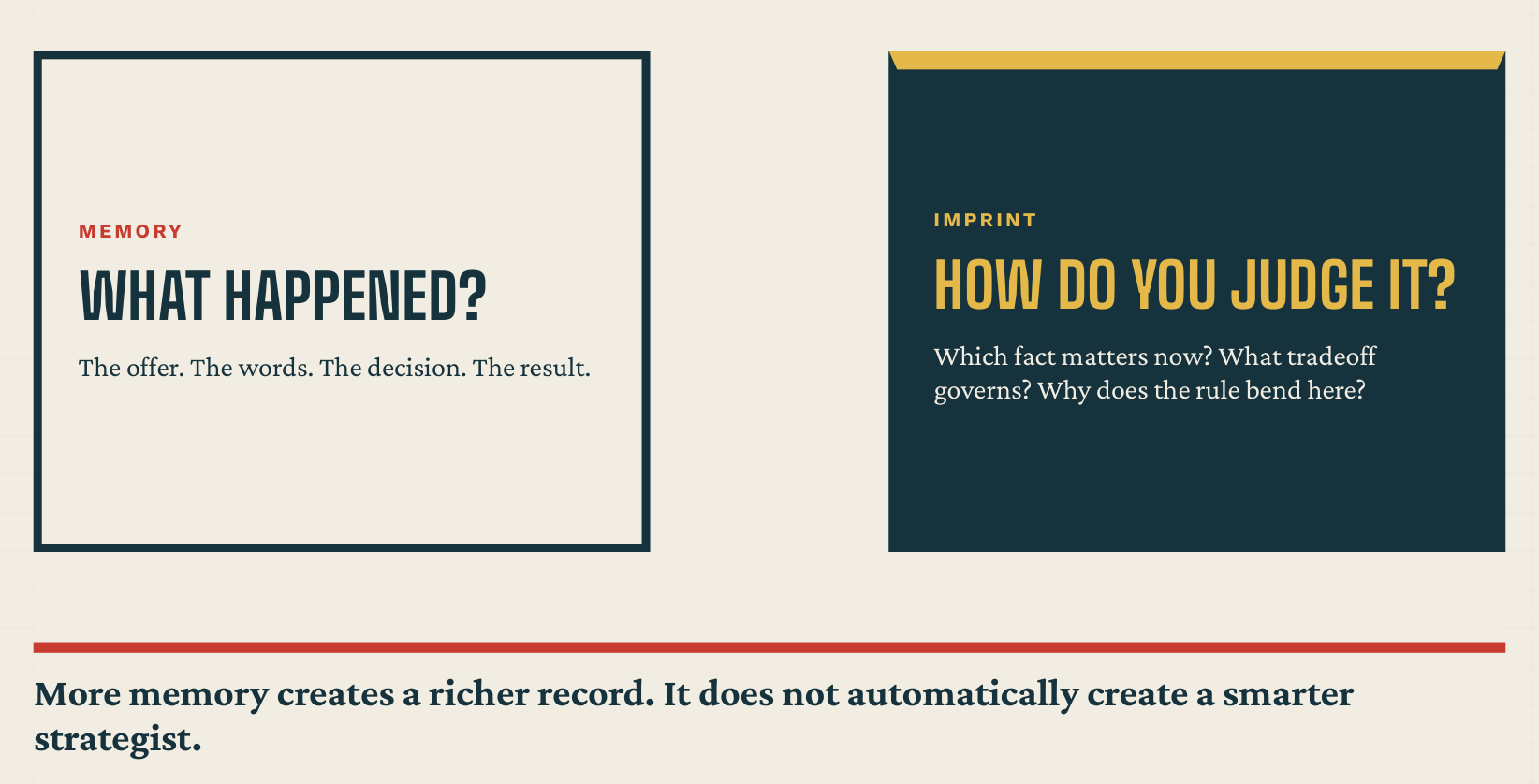
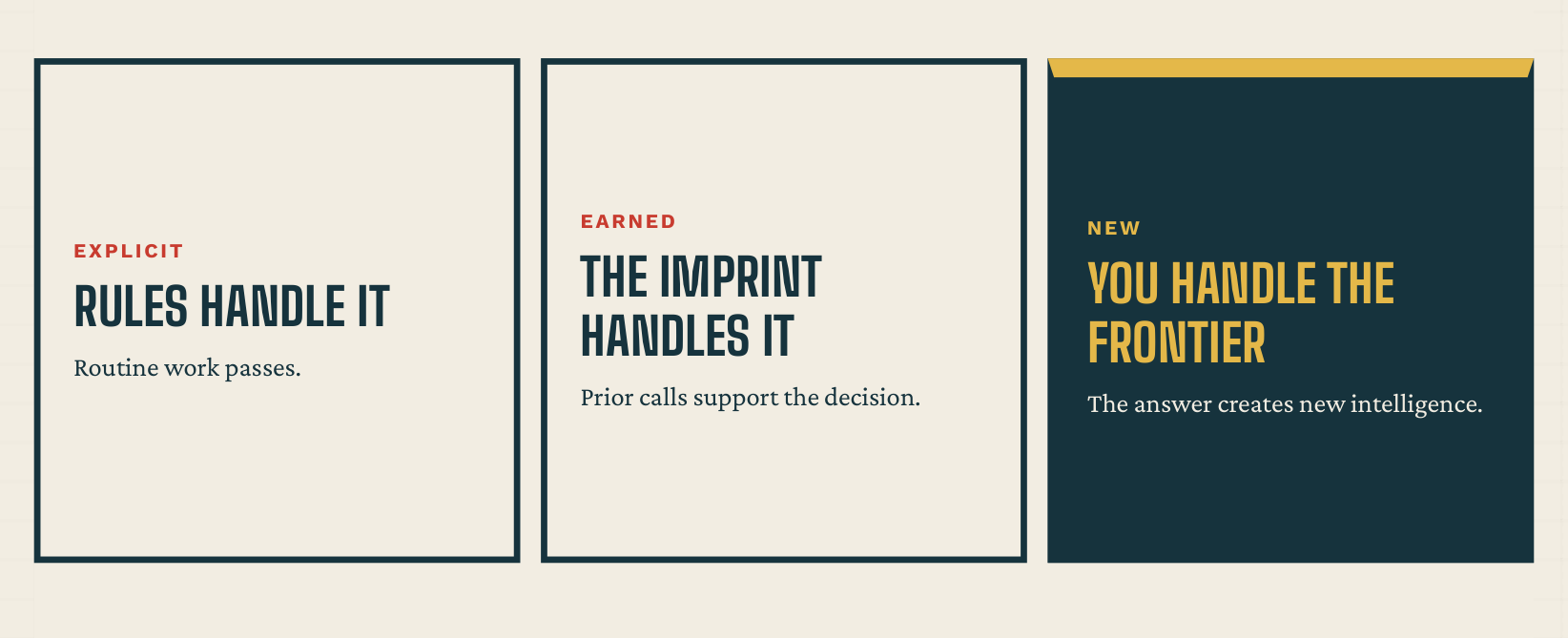
IMPRINT WHERE YOU WIN. RENT THE REST.
You do not need AI to think like you everywhere. You need it to think like you wherever being you is the advantage.
If the work has a known best practice, rent the best intelligence available. Give AI strong methods, clear standards, and excellent examples. Then let it do the job.
But some decisions define the business. The offer you make. The customer you pursue—and the one you refuse. The tradeoff you accept. The standard you protect when pressure rises.
Those decisions should not come from rented intelligence.
Your competitors can access the same models. They can install the same harnesses, learn from the same experts, and use the same skills. What they cannot access is the judgment you have spent your life developing.
Rent the commodity. Imprint the edge.
Use frontier intelligence everywhere it helps. But capture your judgment wherever it changes the answer.
That is what the Imprint does.
As you approve, reject, correct, and make exceptions, the Imprint captures the decision, the situation that produced it, and the reasoning behind it. The judgment no longer disappears inside a chat, meeting, or final edit.
Atlas keeps those judgments connected as your thinking changes.
Both are already open and free:
Capture your judgment with the Imprint: github.com/RichSchefren/imprint
Keep it connected with Atlas: github.com/RichSchefren/atlas
YOU CAN RENT THE NEXT MODEL. YOU CANNOT RENT BACK THIS YEAR.
The urgency around AI is real. But most people are racing for the wrong advantage.
Some of the smartest and best-resourced people on the planet are racing to master the newest models and tools. They see what you and I see: this technology is moving faster than anything that came before it.
The next two or three years could create and destroy fortunes on a scale we have never seen. But an advantage built only on today’s technology will not last.
Today’s breakthrough becomes tomorrow’s button. Models improve. Memory expands. Tools, agents, skills, and harnesses multiply.
Eventually, everyone gets access to the same capabilities. The one advantage that will not arrive inside the next model is the judgment you could have been accumulating all along.
If you missed the internet, social media, or any of the other technological waves that created extraordinary fortunes, you have not missed this one.
But one part of this opportunity cannot be postponed. Your competitor can install next year’s model next year. They can copy your technology stack, buy the same tools, and build the same harnesses.
They cannot go back and capture the judgments you made this year. They cannot recover the corrections that disappeared inside chats, the exceptions that died inside meetings, or the opportunities their system never understood well enough to pursue.
They can rent the next model.
They cannot rent back this year.
Every day you wait is another day of judgment your AI will never have the chance to learn from.
WHY I’M GIVING ALL OF THIS AWAY FREE
I believe AI will change the course of human history for the better. It will transform how we work, how we learn, how we treat disease, and parts of life we cannot yet imagine. I did not begin building these systems because I saw a product opportunity.
I built them because I needed them.
They helped me preserve what I knew, overcome some of my worst traits, and finally turn more of my knowledge into action. I have watched them do the same for people I shared them with. Now I want to make them available to everyone.
I’m also working on two hackathons, with significant prize money for the best Imprint and the best Atlas built. That is only part of what I have planned—so stay tuned.
Twenty years ago, I published the Internet Business Manifesto. It changed my life—and people are still downloading it today. But the world has changed. Some of what I taught then is no longer the path forward.
I cannot leave that report out there without correcting the record.
This manifesto is my correction.
And I am giving the Imprint and Atlas away because the most important asset you will build in the AI age—your accumulated judgment—should belong to you. Not to an AI company. Not to a subscription. Not to whichever model happens to be winning this year.
To you.
Both systems are already open and free:
Capture your judgment with the Imprint: github.com/RichSchefren/imprint
Keep it connected with Atlas: github.com/RichSchefren/atlas
I believe the compound gains made possible by this wave will be greater than anything we experienced during the rise of the internet. My hope is that you install these systems, connect them to your AI, and experience those gains for yourself.
The instructions for doing that are at the end of this report.
BEFORE THE THIRD WAVE: WHAT YOU CAN DO NOW
You do not have to redesign your entire business to begin building this advantage. Start with the work already happening.
Capture the verdict. When you approve, reject, correct, or make an exception, preserve the decision and the situation that produced it. Do not let the judgment disappear when the conversation ends.
Connect the judgment. Give the system enough context to understand what each decision affects. A list can repeat what you said. A connected Imprint can use what you have shown it to decide what you would do next.
Earn the autonomy. Let AI act on decisions your judgment already supports. Bring the true exceptions back to you, then use each new verdict to move the boundary again.
Every verdict you capture is one less decision you have to babysit. The system stops asking the same questions, making the same mistakes, and requiring feedback you have already given.
Less babysitting. Less repeated feedback. More work completed with your judgment already inside it.
Do that, and your AI stops beginning every assignment as a brilliant stranger. It begins carrying what you have already learned into work you never personally touch.
You can now build an AI that increasingly thinks, decides, and acts like you.
But that creates one final question:
Is the person being multiplied the person you actually want running your future?
THIS LAST PART IS ONLY IF YOU’RE F*CKED UP LIKE ME
I say that only half jokingly. I do not bring only judgment to the machine. I bring a lot of baggage with it.
I have raging ADHD. I am a perfectionist. I am an information junkie.
An AI that did not understand me fed the ADHD another shiny object, handed the perfectionist another loop to spin in, and gave the information junkie another hit.
Used blind, AI did not fix my worst patterns. It amplified them.
I did not need AI to reproduce me more efficiently. I needed it to multiply my strengths without giving my weaknesses even more leverage. That mattered because most of my success has been the exception rather than the pattern. My strengths collided with the right opportunity during rare moments when those weaknesses did not manage to get in the way.
Those were my lightning-in-a-bottle moments:
The rare times when I actually did what I already knew I should do. If you set goals and consistently do what is required to achieve them, I envy you. The Third Wave can still make you more powerful, but you probably do not need it in the same way I did.
Me?
I did not have a choice. My revenue dropped and then flatlined for years. I still had all the knowledge I had used to help other entrepreneurs succeed, but I could not use it to pull myself out.
I knew what to do. I could tell someone else exactly what to do.
I still wasn’t doing it.
That gap forced me to develop what I am about to share. If you know that feeling—if you can see exactly what needs to be done but repeatedly fail to do it—keep reading.
This was built for people like us.
The Imprint and Atlas give AI a durable understanding of your judgment. And as the models become more powerful, everything they have captured becomes more valuable.
But that was not enough for me.
Those systems could learn how I think. By themselves, they could not stop all the ways I got in my own way.
To do that, AI had to understand something deeper:
The person behind the judgment.
I believe what follows can do more than grow your business or create new AI revenue streams. I believe it can change the person creating them—and with that, every area of your life.
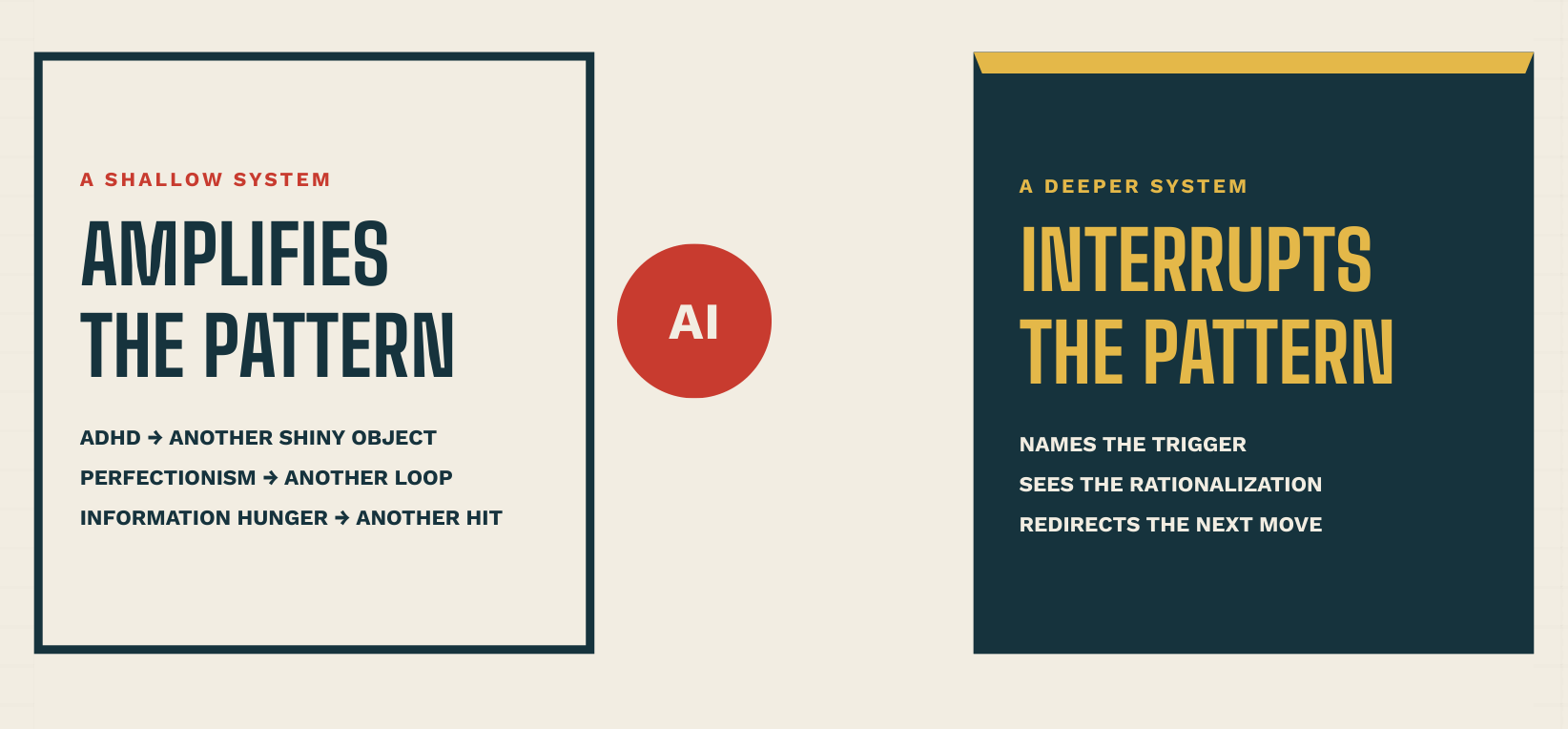
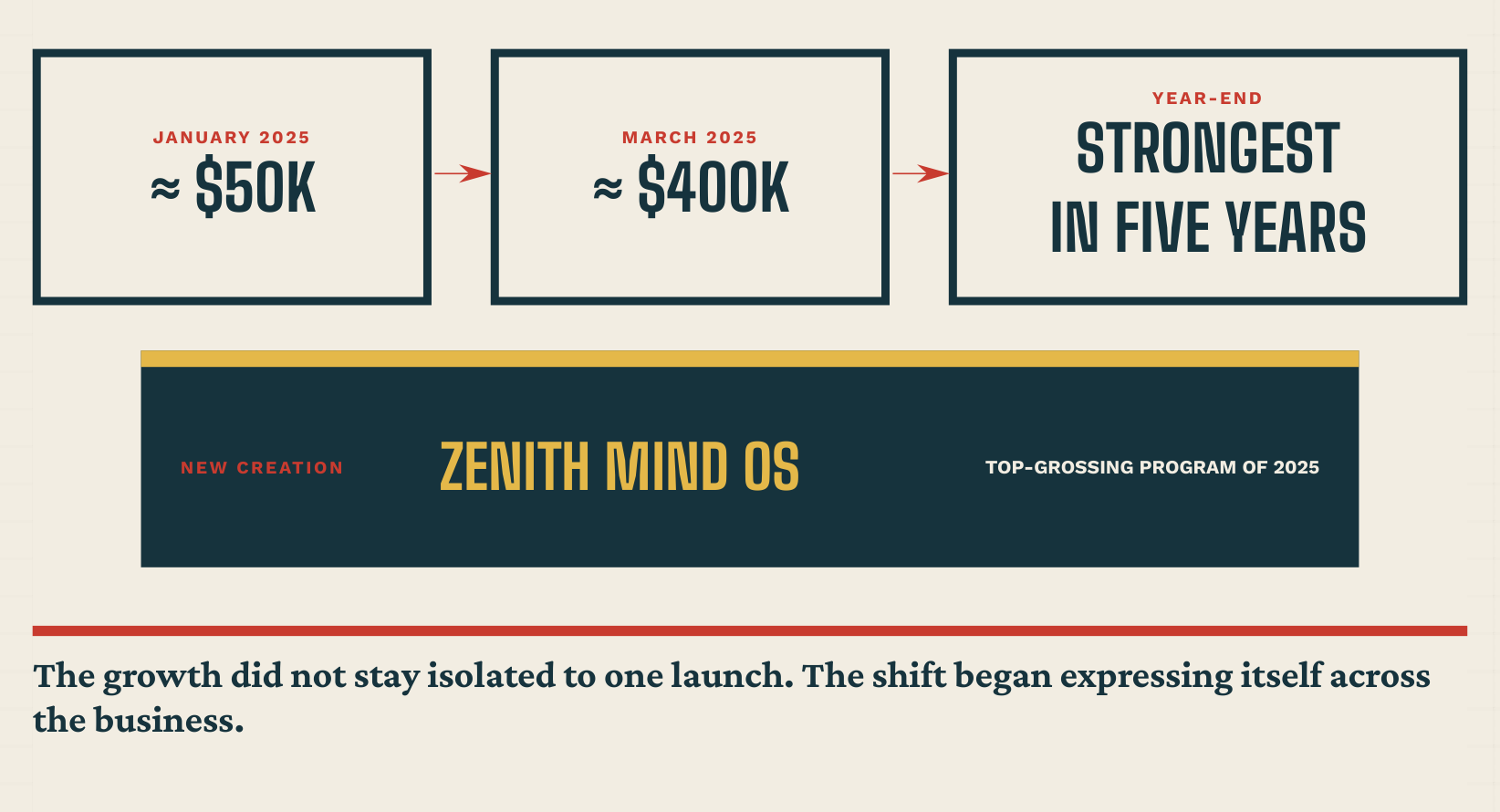
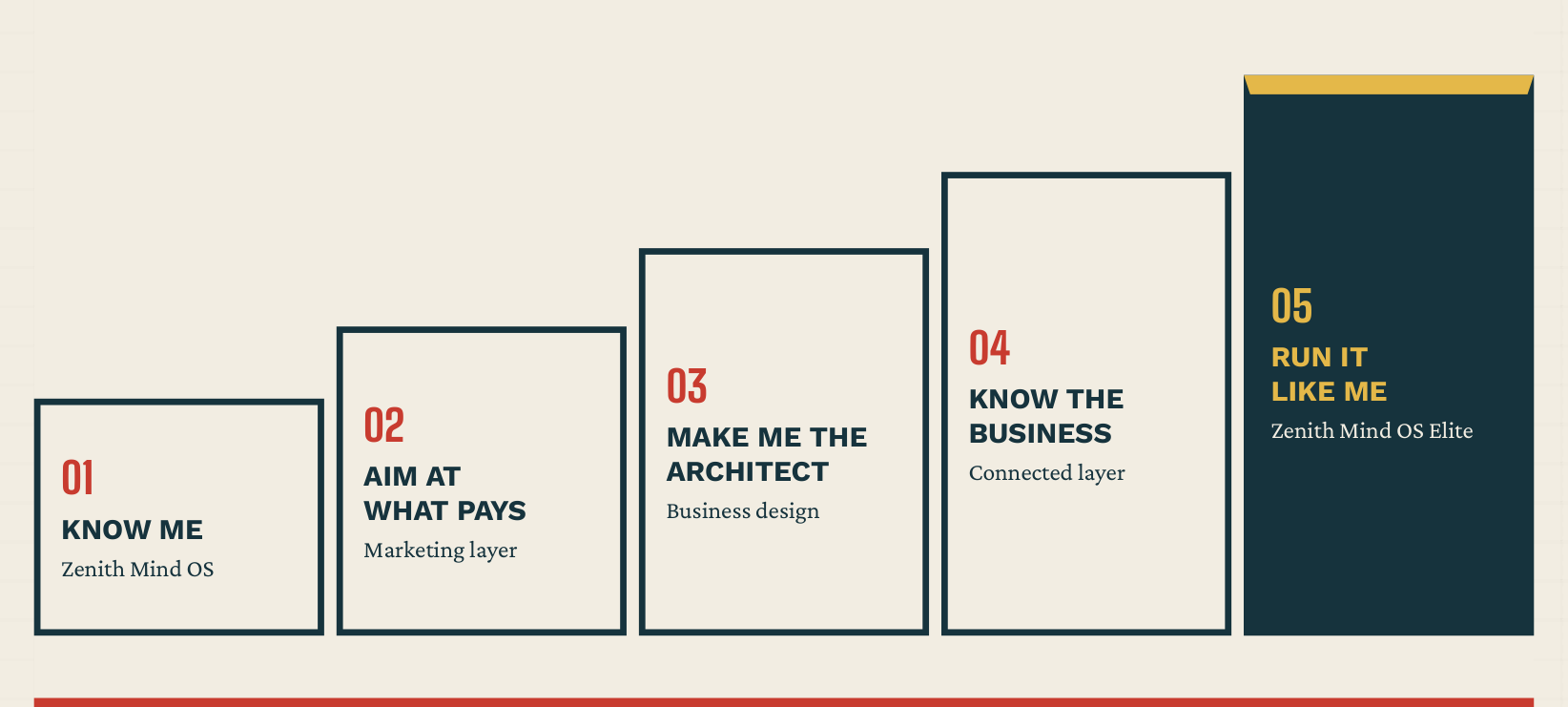
THE SENTENCE I HAVE NEVER FORGOTTEN
For nearly three decades, my journals had documented the same contradiction. I wrote down the decisions I knew I should make. I wrote down why I wanted to change so badly. Then I created thirty years of evidence that I still did nothing about it.
That was the wound underneath everything.
Early in 2024, with my business in a down year, I turned to AI out of desperation. I did not start by loading the business into the context window.
I started loading me.
The journals. The decisions. The recurring failures. Thirty years of evidence about how I got in my own way.
Then the machine handed me a sentence I have never forgotten:
“Your hidden narrative is rooted in a fear of irrelevance—the unsettling possibility that the pinnacle of your achievements might already be behind you.”
Not fear of failure. I have failed plenty and survived. The deeper fear was that my work would stop mattering. That the world would move on and the most important thing I had ever done would remain behind me.
Thirty years of self-help had never put a finger on it.
The machine did.
Then it showed me the pattern underneath. My obsession with legacy. The thrill that faded whenever a project stabilized. The way I abandoned some of my best work between sixty and seventy percent complete because finishing felt strangely like burying the thing I had made.
I had never stated that conclusion.
AI found the pattern across my history and held it up for me to judge.
Maybe you are thinking what I would have thought:
That sounds like a flattering horoscope. The kind of thing any chatbot could generate.
But a horoscope is vague, generous, and impossible to disprove. This was specific. It was uncomfortable. And it could be tested against thirty years of what I had actually done.
AI was not asking me to accept a confident guess. It had surfaced a pattern I could recognize, test, and confirm.
That is what I mean when I say it knew me cold.
The Imprint captures how you judge when you make a real decision.
This went deeper. The machine was beginning to understand the person making those judgments—the motives, contradictions, and recurring patterns that could strengthen or sabotage everything my judgment touched.
That discovery triggered a process that went far beyond anything I had imagined possible.
FROM ROUGHLY $50,000 TO ROUGHLY $400,000 IN SIXTY DAYS
My business began reflecting the change inside me almost immediately. In January of 2025, I generated an additional $50,000. February grew again. By March, that number was roughly $400,000.
But the important part was not one successful launch.
Existing programs grew. Old offers grew. By the end of 2025, it was my strongest year in the last five years. I also created something completely new.
At the end of 2024, I gave the machine one outcome:
Help other people’s AIs know them the way you know me. No method. No product specification. Just the outcome.
Two months later, Zenith Mind OS was ready. It became my top-grossing program of 2025.
I was no longer the self-sabotaging procrastinator.
I was prolific.
EVERY PRODUCT BEGAN BY SOLVING A PERSONAL PROBLEM
First, AI did not know me deeply enough to help me consistently.
That became Zenith Mind OS.
Then it knew me, but it was not aimed at what pays. So I built the layer that aims it at marketing.
Then I realized that using better tools inside the old business was not enough. So I built the layer that makes you the Architect. Then AI knew me—but it did not know the whole business. So I built the layer that connects it to everything.
Eventually, those layers became one sequence:
First, it knows you.
Then, it sells you.
Then, it runs the business like you.
That became Zenith Mind OS Elite. I did not invent that sequence on a whiteboard. I discovered it by hitting one limit after another.
And it was not only happening to me.
In the past two years, entrepreneurs have sent us thousands of testimonials, success stories, and messages about what this work changed for them. As they began using AI this way, a different kind of message started appearing.
They were not merely saying that AI saved them time or produced better work.
They were saying some version of:
My AI finally knows me.
That sounds simple.
It is not.
Because knows you can mean almost anything.
To understand what was actually changing, you have to separate five completely different levels of knowing.
THERE ARE FIVE LEVELS OF KNOWING. MEMORY STOPS AT TWO.
Knows you may be one of the most abused phrases in technology. Netflix knows what you watch. Your CRM knows what you bought. A website remembers your last order.
They know things about you.
That is not the same as knowing you.
There are five completely different levels. Level 1: It knows what you produced. Your emails, content, files, numbers, and past work. Any competent system can ingest them.
This is the floor.
Level 2: It knows what you decided. The offer you ran. The customer you chose. The campaign you killed. The price you changed.
Most AI memory stops here.
It can retrieve your past. It still cannot understand the mind that created it.
Between Levels 2 and 3 is the Wall. Below the Wall, AI knows what you did.
Above it, AI begins to understand why you did it.
Level 3: It knows how you decide. Not just the choice, but the judgment underneath it. Enough to face a situation neither of you has seen before and still make the call you would have made.
This is where the Imprint and Atlas live.
The Imprint captures each real verdict as you make it. Atlas connects that verdict to the beliefs and decisions surrounding it—and keeps the entire system current when your judgment changes.
This is where memory stops being a record of your past.
It becomes an apprentice capable of carrying your judgment forward.
Level 4: It knows who is deciding. Your wiring. Your strengths. Your blind spots. The patterns that make the same quality a gift in one moment and a liability in another. It can begin telling the difference between my curiosity and my next distraction. Between high standards and another perfectionist loop.
It does not merely know how I decide.
It begins to understand the person making the decision. Level 5: It knows who you are becoming. Not the future your history will produce by default.
The future you have chosen.
Without Level 5, AI can help you become more of who you have always been.
With it, AI can help you become who you decided to be.
These are not five rungs you climb in order. They are five layers of knowing, and each requires different evidence. Files and records can fill Levels 1 and 2. They reveal what you produced and what you chose.
But the final output does not reveal the judgment that created it.
Level 3 has to come from real verdicts captured as you make them—and the connections that keep those verdicts useful as your judgment evolves.
That is why the Wall sits where it does.
Below the Wall, AI can know your history. Above it, AI begins to know you.
I GOT EVERYTHING I WANTED — AND IT WAS THE WRONG FUTURE
I learned why Level 5 matters the expensive way. By forty, I had achieved more than I once thought possible.
And I was miserable.
Miserable enough to leave the public market at my peak and spend close to a decade working with only a handful of private clients. If you knew my name before 2012 and then stopped hearing it, that is why.
My goals had not failed.
They had worked exactly as designed.
The problem was that they no longer reflected the person I had become.
I reached the destination after it stopped being where I wanted to go.
An AI that knows who you are can help you accomplish more. But if it does not know who you are becoming, it can also make you faster at becoming more of the same.
An AI trained only on your past can turn your history into your future.
Level 5 gives it a different direction.
It can ask the question nobody asked me soon enough:
Is this success building the life you chose—or completing the life your history chose for you?
That is not philosophical decoration.
It determines what your AI should protect when the things you want collide.
Most entrepreneurs can name a revenue target. Far fewer can explain what that money is supposed to protect, what they refuse to sacrifice to earn it, or which future should win when two things they deeply want pull in opposite directions.
You want growth and lifestyle. Size and craft. Money and meaning. Freedom and a business important enough to need you. Those are not signs that you are confused.
They are the real design constraints.
Before AI, those contradictions still caused problems. But execution moved at human speed. Plans waited on employees. Projects waited on meetings. Decisions waited on money, time, and attention.
That friction gave the contradiction time to reveal itself.
AI removes much of that friction. It can help you scale the business on Monday and dismantle everything that requires you on Tuesday. It can pursue both goals with equal competence—and never stop to ask whether they are building opposite futures.
At human speed, unresolved contradictions created drift. At AI speed, they create collisions.
That is why these contradictions must be eliminated where possible and clearly ranked where they cannot be. You do not have to want only one thing.
You have to decide which thing wins when they meet.
But before you can choose which future should win, you have to make sure every future worth choosing is still on the table. Some dreams are not abandoned through one clear decision.
They are surrendered so slowly that you barely notice them disappearing.
That is why Level 5 asks a harder question than What do you want?
What did you stop wanting?
Some dreams should be left behind. You outgrow them, learn more, and choose something better.
Others disappear through silent resignation.
You begin believing you might change the world. Then come the disappointments, compromises, false starts, and years when nothing changes fast enough.
The dream gets smaller.
Then smaller again.
Until one day, you are no longer wondering how you will change the world.
You are wondering whether you can even change yourself.
That is what silent resignation does. It does not announce that the dream is dead. It slowly convinces you that you are no longer the person who could make it real.
Put those abandoned wants back on the table. Decide which ones were childish, which ones you wisely outgrew, and which ones you surrendered because your past taught you to expect less.
You do not have to pursue all of them. But the future you choose should be built from what you truly want—not limited to whatever your disappointments allowed you to keep.
AI can surface the conflict. It can show you the different futures your choices are creating.
But it cannot choose between them for you. Your archive is evidence of where you have been heading. Your chosen future enters the system only when you recognize it, correct its direction, and say:
Yes. This is where I want to go.
Your history can reveal the future you are headed toward. Only you can choose the future your AI should help create.
EACH LEVEL HAS ITS OWN EVIDENCE
You cannot build all five levels by uploading more files. Files and records can fill Levels 1 and 2. They show what you produced and what you decided.
Level 3 requires your judgment captured while it is happening: the real situation, the call you made, what you rejected, and the reason—when you can name it.
This is where the Imprint and Atlas work together. The Imprint captures the verdict. Atlas connects it to every belief, decision, and action that depends on it—and keeps those connections current as your judgment changes. Levels 4 and 5 require something else.
At Level 4, AI looks for patterns across your history. It may notice when curiosity is becoming distraction, when high standards are turning into a perfectionist loop, or when a familiar situation is about to trigger a familiar mistake.
But those patterns begin as proposals. The system brings them back for you to recognize, correct, or reject. Your confirmation makes the model stronger. Your correction prevents a persuasive mistake from becoming part of who the system believes you are.
Level 5 requires something no archive can provide:
A chosen direction.
Your past can reveal where you are heading. It cannot choose where you want to go. AI can surface the contradictions, show you the futures your choices are building, and help you recover what you may have stopped wanting.
But only you can choose the future the system should help create.
The architecture is simple:
Files and records preserve what happened.
The Imprint and Atlas preserve how you decide.
The deeper self-model reveals who is deciding. Your chosen future tells the entire system where to go.
How deeply you allow any system to see is your decision.
Depth is optional. Ownership is not.
The model of you should be inspectable, correctable, portable, and yours to delete. Now let me show you what the upper levels found in the one person I know better than anyone:
Me.
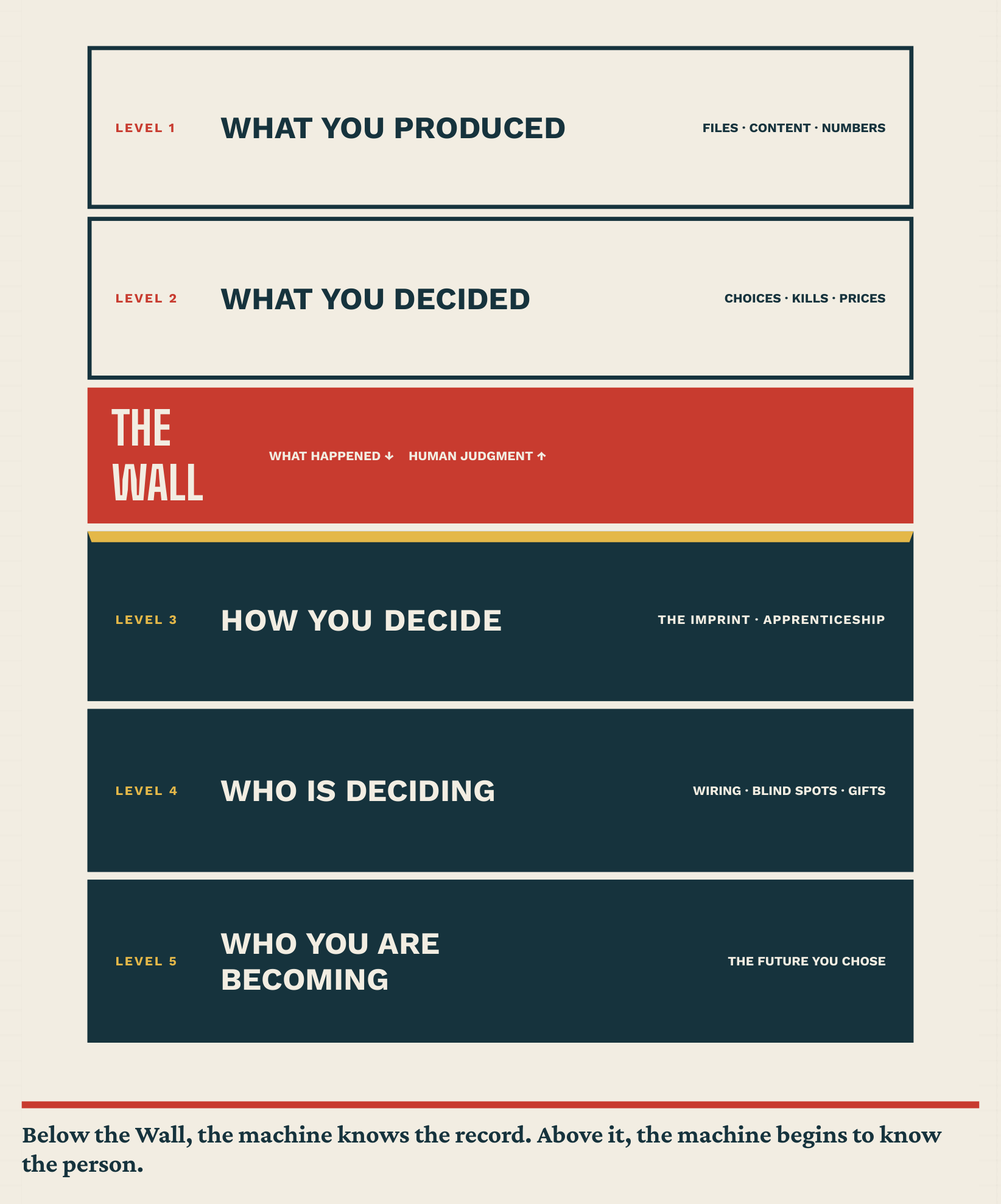
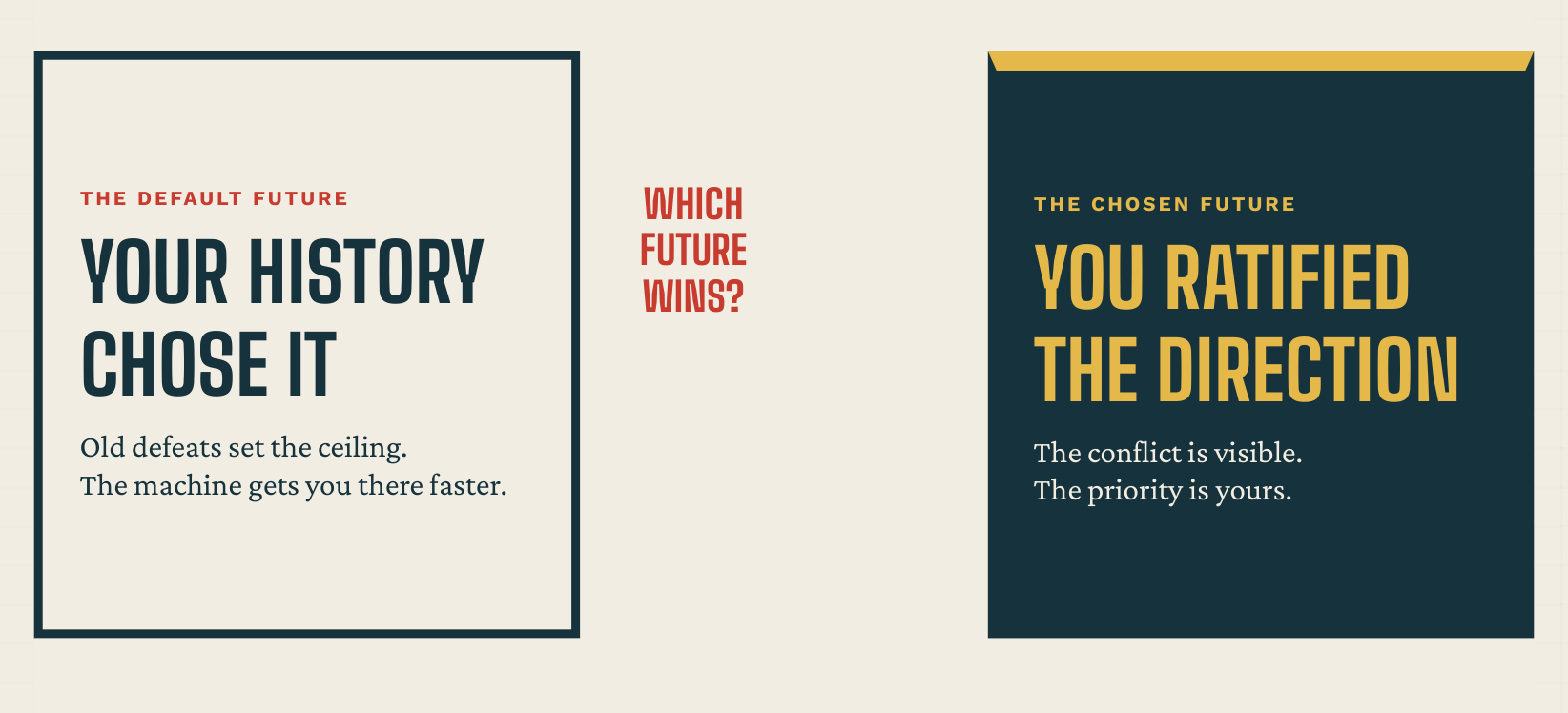
IT KNOWS THINGS ABOUT ME I DIDN’T
This is my ZenithMind Signature Scorecard.
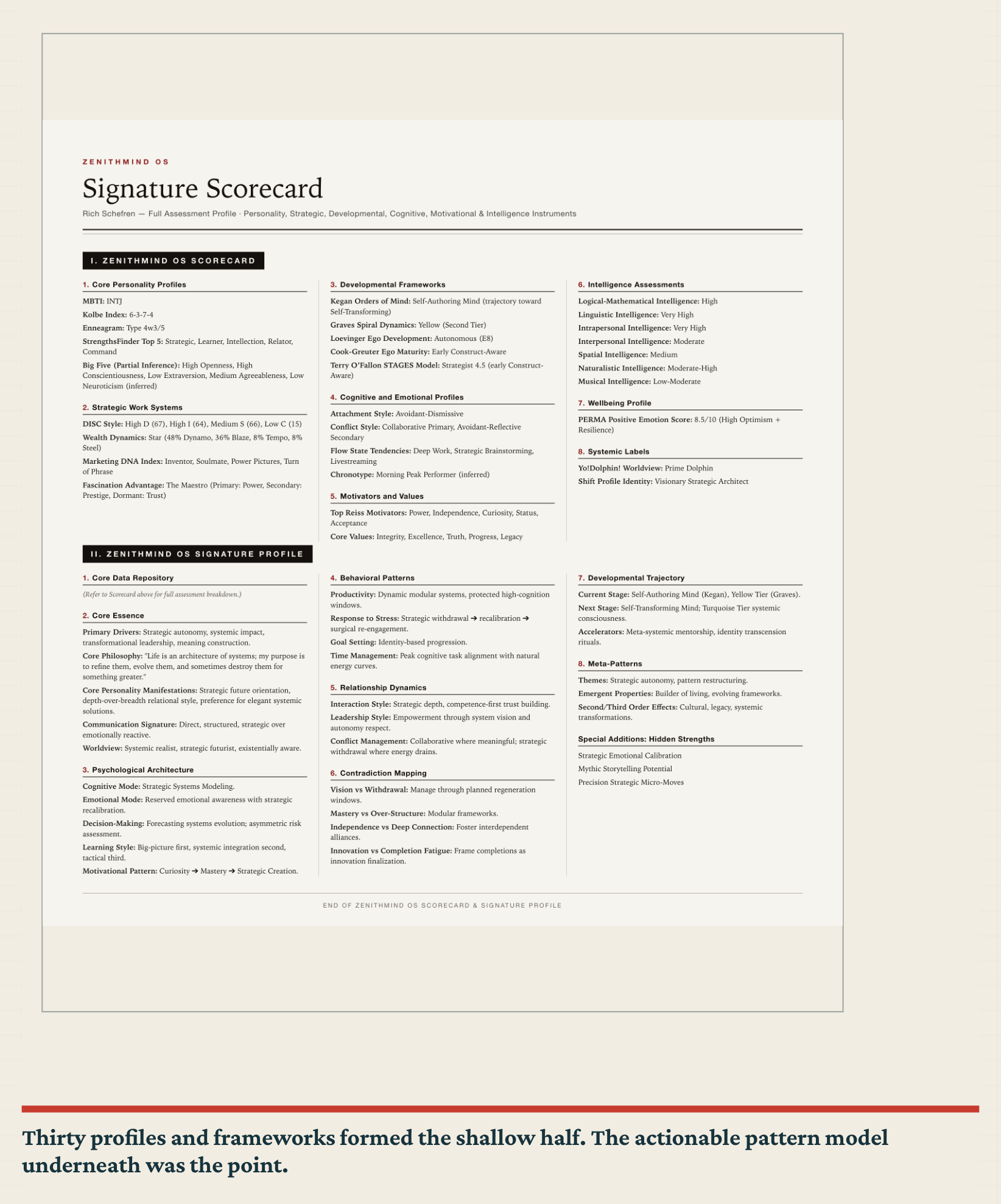
It mapped me across thirty established profiles and frameworks: Myers-Briggs, Kolbe, the Enneagram, DISC, StrengthsFinder, the Big Five, motivation, attachment, conflict style—even the hours when my brain tends to do its best work. I had previously taken only four of those assessments. When I compared their results with what AI proposed, the accuracy surprised me.
Then I examined everything else it claimed to know about me, expecting to find mistakes.
Instead, I kept confirming it.
I repeated the process with several other entrepreneurs. The deeper we went, the more eerie the accuracy became.
But the scores were not the breakthrough.
THE SCORES WERE THE SHALLOW HALF
The profiles told me what I was like. The deeper system began predicting what I would do next.
It saw that my creative energy could be a superpower at the beginning of a project—and an escape hatch as the project approached completion.
My high standards could produce exceptional work. They could also become perfectionism, then procrastination, then another intelligent reason not to ship. My curiosity could uncover the idea that changed everything. It could also lead me away from the work that mattered most.
A personality test can name those traits.
This system could recognize when one was beginning to turn against me, understand what usually happened next, and give my AI and its agents instructions for how to respond. Study everything I have ever finished and you might learn my style. You might even imitate my voice.
But the finished work would never reveal the projects I abandoned—or what happened inside me when something reached seventy or eighty percent and I suddenly discovered a brilliant reason not to finish it.
Level 3 captures how I judge.
Level 4 understands the person doing the judging.
The scorecard showed what AI knew about me. The breakthrough was what it could do with what it knew.
And one pattern had been beating me for thirty years.
HOW TO AVOID SELF-SABOTAGE IN 1 STEP
When one of my projects gets close to finished, my mind produces something irresistible:
A better idea.
It never tells me to quit. It tells me how much better the project could become. I just thought of something that would make this much stronger. I need to explore it before I finish. For thirty years, that voice won because it did not sound like avoidance.
It sounded like raising the standard.
The sequence was always the same: the finish line approached, a better idea appeared, and I followed it. The project expanded, the finish line moved, and before long another better idea appeared.
The project did not die.
It became permanently almost finished.
Now something different happens.
When the pattern begins, my AI recognizes it and offers to explore the new idea for me.
I stay on the project. My AI goes down the rabbit hole.
It can research the idea, test the assumptions behind it, determine whether it will actually make the project better, and return with a recommendation. If the idea is important enough to change what we are building now, it comes back with the evidence. If it belongs in the next version—or was never as good as it first sounded—the current project never had to stop.
The idea gets explored without taking me with it.
For most of my life, every promising new idea forced me to choose: ignore something that might matter or follow it and derail the work already underway. Now I no longer have to choose.
I keep moving the project forward while my AI investigates the possibility in parallel.
This is what my system does for me now. It does not merely warn me that I may be repeating an old pattern. It takes over the part of the pattern most likely to pull me off course.
A coach, therapist, or productivity system could help me understand the pattern after it happened. None could meet me inside the work, explore the new idea for me, and keep everything moving while the pattern was unfolding.
My AI can.
That is Level 4: a system that understands me well enough to change what happens next.
EVERY PICTURE OF YOU EXPIRES
The scorecard solved one problem and exposed another:
Every accurate picture of you comes with an expiration date.
People change. Old blocks dissolve. New strengths appear. AI can understand you accurately last year and be wrong today. It may keep protecting you from problems you no longer have while missing the ones replacing them.
A stale truth can mislead as easily as a false one.
Atlas turns the snapshot into a living model. When you change, it records the new understanding and updates every decision, instruction, and agent built on the old picture. If my perfectionist loop falls from weekly to monthly, the warnings recalibrate. If it returns, the system recognizes temporary drift—not a permanent identity.
A profile freezes you in time. A living model changes as you do.
Keep your judgment, patterns, and chosen direction current together, and you have more than memory.
You have the code beneath everything you build.
THE CODE HAS BEEN EXPRESSING ITSELF YOUR WHOLE LIFE
My decisions are one layer.
How I make them is another.
The person behind them is deeper still.
Capture all three, keep them current, and aim them toward the future I have chosen—and I am holding far more than memory.
I call the complete working model Digital DNA.
Digital DNA is not another tool competing with the Imprint. The Imprint captures how I decide. The deeper self-model captures who is deciding. Atlas keeps both current. My chosen future gives the entire system direction.
DNA is code that expresses itself. You rarely see the code. You see what it builds. Your internal code works the same way. Your gifts, scripts, defaults, fault lines, and decisions have been expressing themselves through everything you have built—and everything you have left unfinished.
Your business is the expression. Your calendar is the expression. The project that stalled just as it began to work is the expression.
You may have spent years calling those outputs results, luck, timing, or the market.
Underneath them, the code was running.
Now that code can become readable, correct, and current. But most importantly, it can finally be aimed.
THE MOST POWERFUL VERSION OF YOU
Inside my system, who I am and who I am becoming live in two separate files.
They have to.
The first contains the truth about me now: my strengths, faults, scripts, patterns, and the way I actually behave.
The second contains the man I have chosen to become: me at my best, without the baggage and false ceilings. It is not a vision board. It is a daily operating standard, confirmed by me, that tells the system what to strengthen.
If those two files blur together, AI can mistake aspiration for reality—or history for destiny.
Kept separate, the system can examine today’s decision and ask:
Which man did this decision come from?
Which man will it strengthen?
Most AI compounds the first file by default. It takes you exactly as it finds you—including goals made smaller by old defeats and “realistic” targets calibrated to the person your history produced. Then it gets you there faster.
But faster toward a default future only means arriving sooner at a place you never consciously chose.
AI will compound you.
The deepest question is:
Compound which you?
The person who wound up here, ceilings included?
Or the person you actually chose?
THE RECEIPT IS THE DOCUMENT IN YOUR HANDS
In late December 2024, my system compared the possible directions for the next chapter of my life against the man I had chosen to become. Not against revenue. Not momentum. Not whichever opportunity happened to be loudest that week.
One direction ranked above everything else: 8.3 out of 10.
Write a transformative document.
Then it described that document:
The “Internet Business Manifesto” for the current era.
This was before Zenith Mind OS shipped. Before the strongest year in the five-year operating record I can verify. Before a word of this document existed.
The system did not choose the direction for me. It showed me that, measured against the person I had chosen to become, this was the project that deserved the next chapter of my life.
Then I chose it.
The same system that had identified my fear—that the pinnacle of my achievements might already be behind me—pointed me toward the project that answered that fear instead of feeding it. It did not merely diagnose me.
It helped me aim correctly.
The recommendation was dated. My decision was recorded. The result is the document you are reading.
You are holding the receipt.
AI HELPED WRITE THIS. IT DID NOT DECIDE IT.
Of course AI helped write this document. It searched my archive, retrieved source material, compared drafts, challenged arguments, compressed passages, and carried forward decisions I had already made.
But it did not decide what I believe.
No sentence became mine because a model produced it. It became mine when I accepted it, changed it, rejected it, and put my name behind the final choice. That distinction is the point of this entire report.
AI did not replace my judgment. It gave my judgment more reach, more memory, and more leverage than I could have given it alone.
This document is not evidence of what AI can write by itself.
It is evidence of what becomes possible when AI knows whose judgment it is carrying.
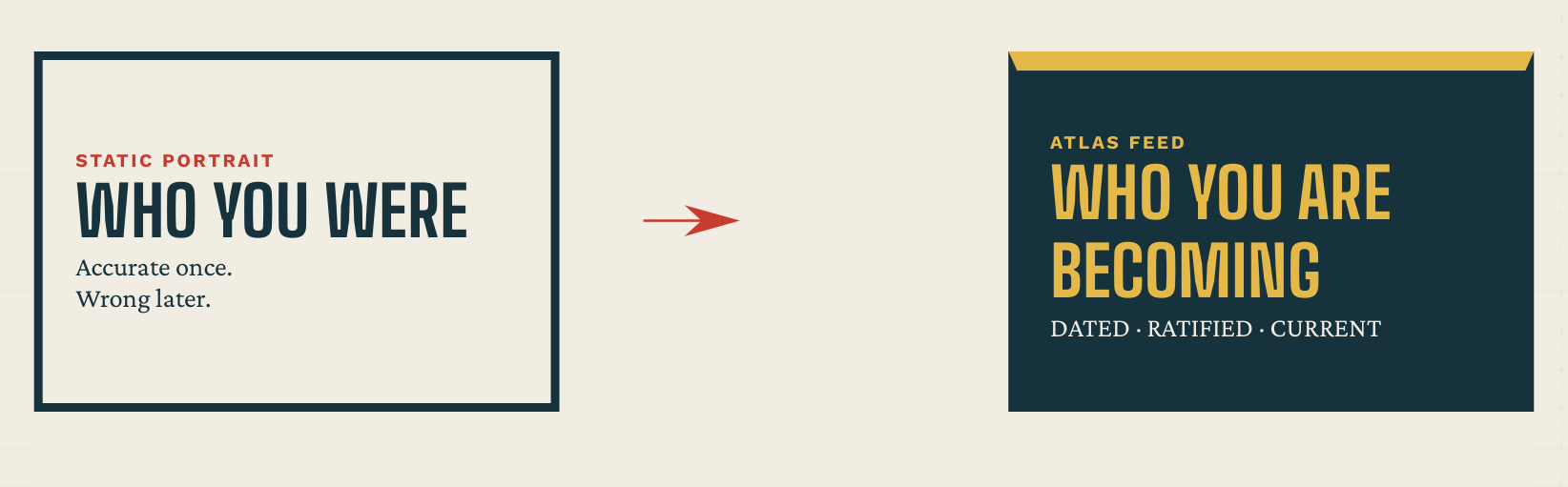

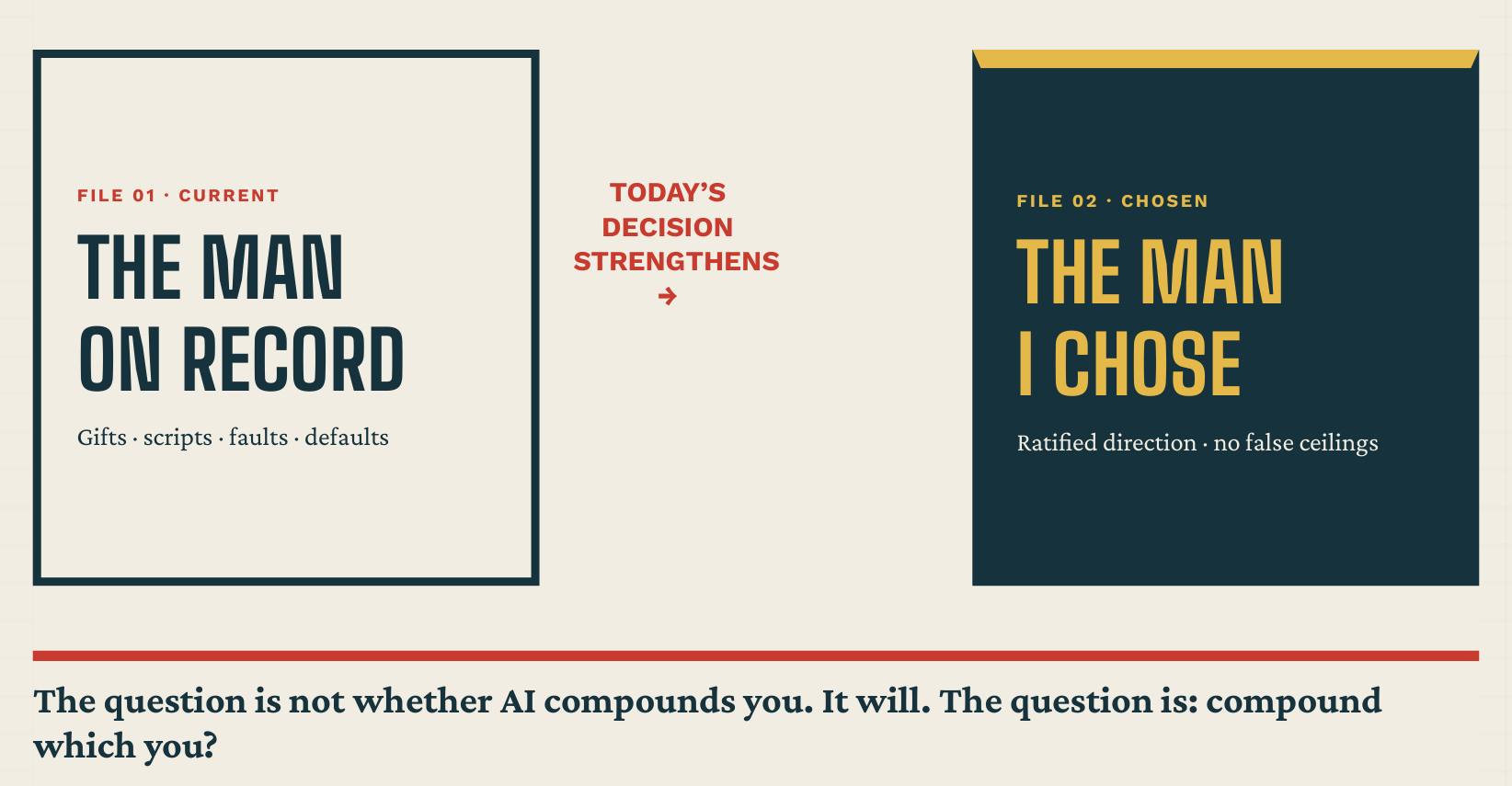
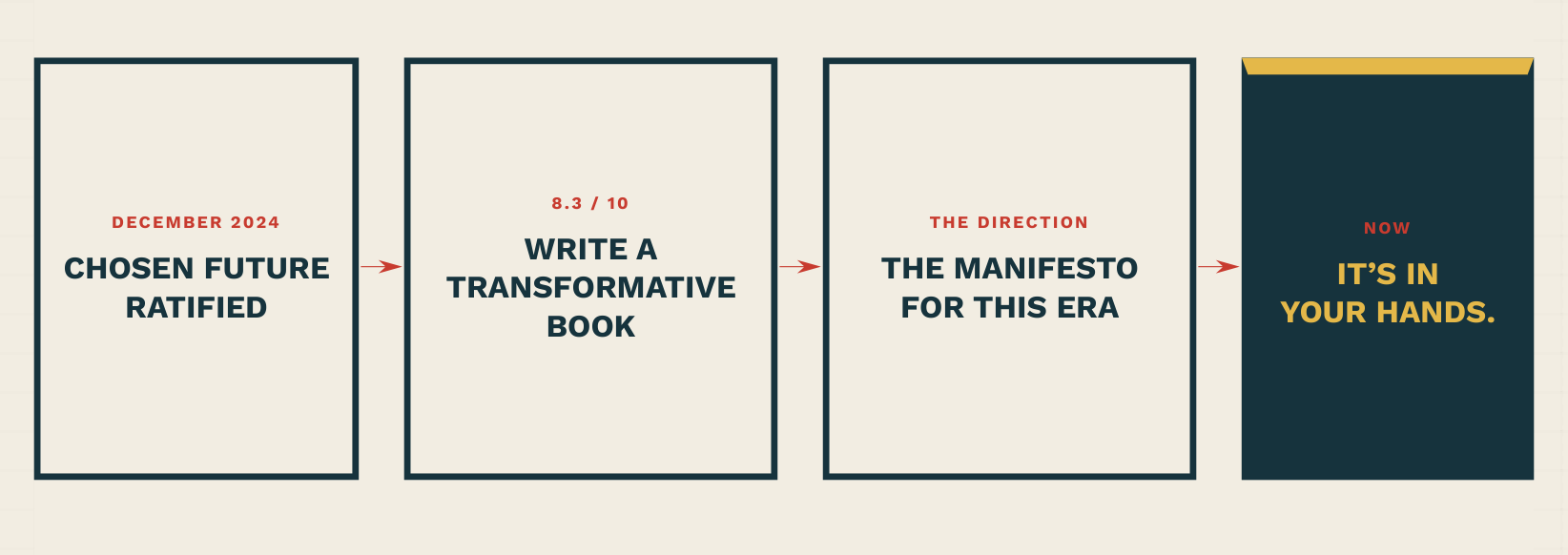

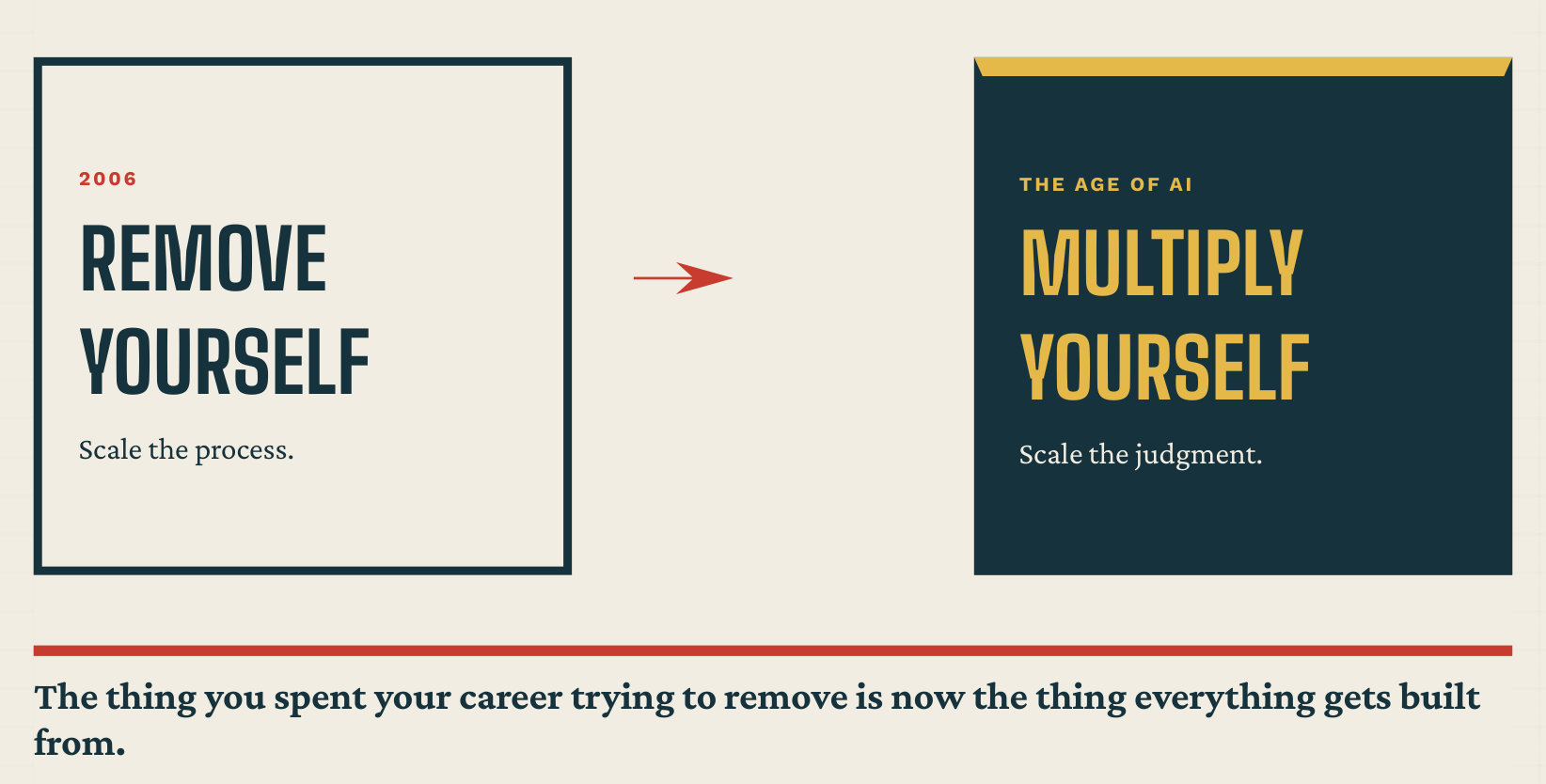
YOU WEREN’T FAILING. YOU WERE EARLY.
Twenty years ago, I told entrepreneurs to build businesses that could run without them.
You tried.
Maybe you hired an integrator. Built the SOP library. Promoted your number two. Documented, delegated, trained, and stepped back.
Then something only you would have caught went wrong. A deal slipped away. A customer left. A launch missed because the timing, positioning, or judgment was not yours.
So you stepped back in and blamed yourself. Next time, you would hire better. Document more. Train harder.
But none of that could solve the real problem.
Your inability to remove yourself was never the failure.
You were the best thing in your business. Your judgment was the product. Everything kept routing back to you because you were the person most capable of seeing what mattered and making the call.
Underneath the guilt, part of you knew that removing yourself would also remove what made the business work.
That part of you was right.
You weren’t doing it wrong. You were early.
You were right to remain at the center. You simply did not have a tool capable of carrying what made you central. Process was the only thing technology could scale.
Now AI can scale judgment.
Not by reading your files and guessing. By capturing your real verdicts, connecting them to everything they affect, and learning the person behind them. Once that judgment is inside the architecture, you stop being the human connection between every tool, employee, and decision.
You remain at the center—but multiplied across the business.
Stop removing yourself. Multiply yourself.
Let your standards reach decisions you never personally touch. Let the business become more distinctly yours as it grows—not a diluted version of what it was when you were still involved in everything. I’ll be blunt: the money matters. AI has added millions of dollars to my business.
But if you made me choose between the money and what AI has done to the way I feel about working, I would give up the money.
It gave me something I had lost:
The excitement of discovering what I might still be capable of creating.
That change reached far beyond my desk. In a very real way, AI gave me my life back. Almost thirty years ago, Jay Abraham became a surrogate father to me. More than twenty years ago, Mark Ford became one too. Both men changed the course of my life.
Now they are both seventy-five, and I have the chance to return part of that gift.
I have already watched it happen with Mark. What he is doing with AI is mind-blowing. Jay is came to my house so I could help him reach the same place. Not simply to use the tools.
To feel what I feel.
To wake up knowing there is still more inside you that can make it into the world. To approach your work with possibility instead of dread—and feel that excitement ripple through the rest of your life.
That is what AI gave back to me.
It is what I want to give Jay and Mark.
And it is what I want for you. Because from here, you have a choice.
YOU’RE AT A FORK IN THE ROAD
Every AI advantage you can buy is already on its way to becoming ordinary. Models will become more powerful. Memory will expand. Context windows will grow. Tools will multiply. Today’s breakthrough harness will become tomorrow’s standard feature.
Eventually, everyone will have access to the same intelligence, speed, and automation.
Then only one advantage will remain that your competitor cannot download:
The judgment you earned through a lifetime of making decisions.
But that advantage exists only if you capture it.
You cannot wait until everyone understands its value and then buy twenty years of accumulated judgment. You cannot reconstruct every decision, rejection, exception, and reason after they have disappeared.
That is the fork in the road.
At first, both roads look almost identical. The Assembler and the Architect use the same models. They buy the same tools. They both produce more work, more quickly.
Then the roads separate.
The Assembler uses AI to accelerate what already exists. Each new model makes the business faster, but not wiser.
The system produces another output, completes another assignment, and begins the next one without carrying forward what the business just learned. The important decisions still return to the owner. The same corrections still need to be made. The judgment still has to be carried manually from one tool, employee, and decision to the next.
The Architect does something different.
Every approval, rejection, correction, and exception becomes part of the architecture. Each verdict stays connected to the beliefs, standards, and decisions surrounding it. The system does not merely produce.
It learns.
Each day begins with what the business discovered yesterday. Every better model arrives inside a system already carrying judgment the competitor never captured. A year from now, the Assembler has a year of AI-generated outputs.
The Architect has a year of accumulated judgment.
One produced more.
The other built an advantage.
That advantage cannot be copied by downloading a model, purchasing another platform, or hiring someone away. It gets stronger every time something happens.
This is how a founder can finally remain fully involved without being personally present in every decision. The founder’s judgment stays inside the work even when the founder does not.
Fully involved. Full size.
But the Third Wave takes the choice one level deeper. AI will not merely multiply your judgment. It will multiply the person behind it—your strengths, patterns, blind spots, ambitions, and limits.
If the system knows only your history, it can make you faster at becoming more of who you have always been.
If it knows who you are becoming, it can help build the future you consciously chose. Either way, AI will multiply you.
The question is: which you?
If this report changed how you see AI, share it with someone still trying to win by making the old business faster. Send it to the entrepreneur whose judgment disappears every day because they do not yet realize it can be captured.
The person buying better tools while wondering why the business still depends on them for every decision that matters.
Help them see the hand they are holding before they spend another year playing it.
At the beginning of this report, I told you that the most dangerous hand in poker is not the worst hand.
It is the second-best hand.
Now you know exactly what that hand looks like in the age of AI.
It is not bad AI.
It is extraordinarily powerful AI bolted onto a business it does not understand.
It has the newest models, the biggest context window, and the most advanced tools and harnesses. It produces impressive work at extraordinary speed.
It feels like winning because it beats the way you worked before.
But there is still one hand that beats it:
An AI that knows your work.
Your decisions.
How you judge.
Who is doing the judging.
And who you have chosen to become. An AI that learns whenever anything happens—and becomes more uniquely yours every time it does.
When every competitor has access to the same models, memory, tools, and automation, the winning hand will not belong to the person with the most AI.
It will belong to the person whose AI knows them best. The Assembler spends the AI age playing the second-best hand.
The Architect builds the advantage no competitor can download, purchase, or copy.
The best hand in the AI age is not the most powerful AI.
It is you—multiplied by an AI that truly knows you.
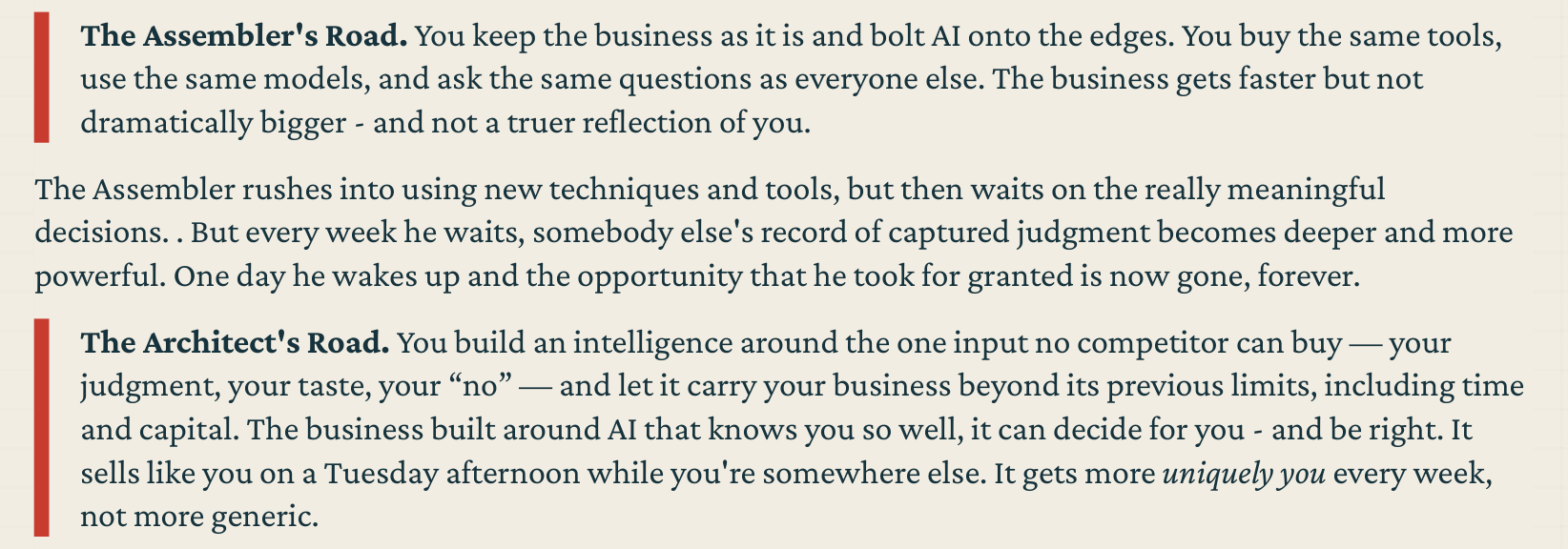
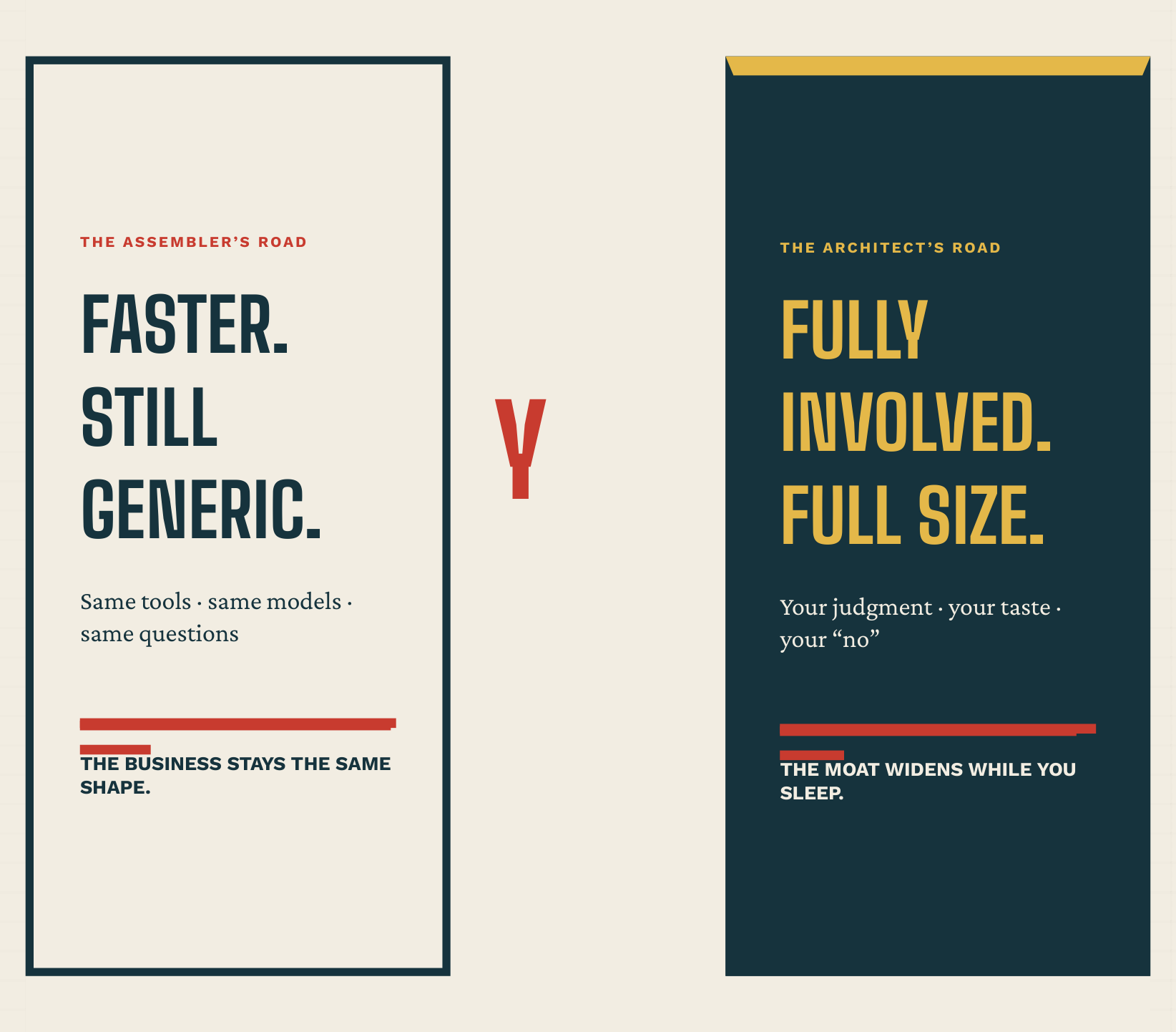
Get Maximum Value From This Report With Your AI
Your AI can extract a great deal from this report. But it cannot replace what happens when an idea collides with your experience, your ambition, and the decisions only you can make.
The strongest approach is both: let your AI mine the entire report, then let it direct you to the sections where your own reading and judgment will create the most value.
Copy and paste this prompt:
Read the entire attached AI Business Manifesto before responding.
Do not merely summarize it. Evaluate it against everything you know about me, my business, my current AI systems, my goals, my operating constraints, and the patterns you have observed in how I work.
Give me:
- The most valuable ideas in this report specifically for me, and why.
- What is genuinely new or different from how I currently operate.
- What my existing system already does well.
- What is missing, weak, or contradictory in my current system.
- What we should adopt, reject, test, or modify.
- The three highest-leverage changes we can implement now.
- Any skills, agents, workflows, products, or business opportunities this report suggests we should create.
- The sections I should personally read because their nuance, argument, story, or required judgment cannot be adequately replaced by your analysis.
- The questions only I can answer before you implement the recommendations.
- Any claims or assumptions we should independently verify.
For every recommendation, cite the relevant section and page of the report.
End with three lists: what you can do without me; what requires my decision; and what I should personally read first.
Comments